Decision Intelligence vs Closed-Loop Intelligence: Where the Decision Ends and the Loop Begins
Decision intelligence improves a decision. Closed-Loop Intelligence carries it through accountable action, verified outcome and retained institutional learning.
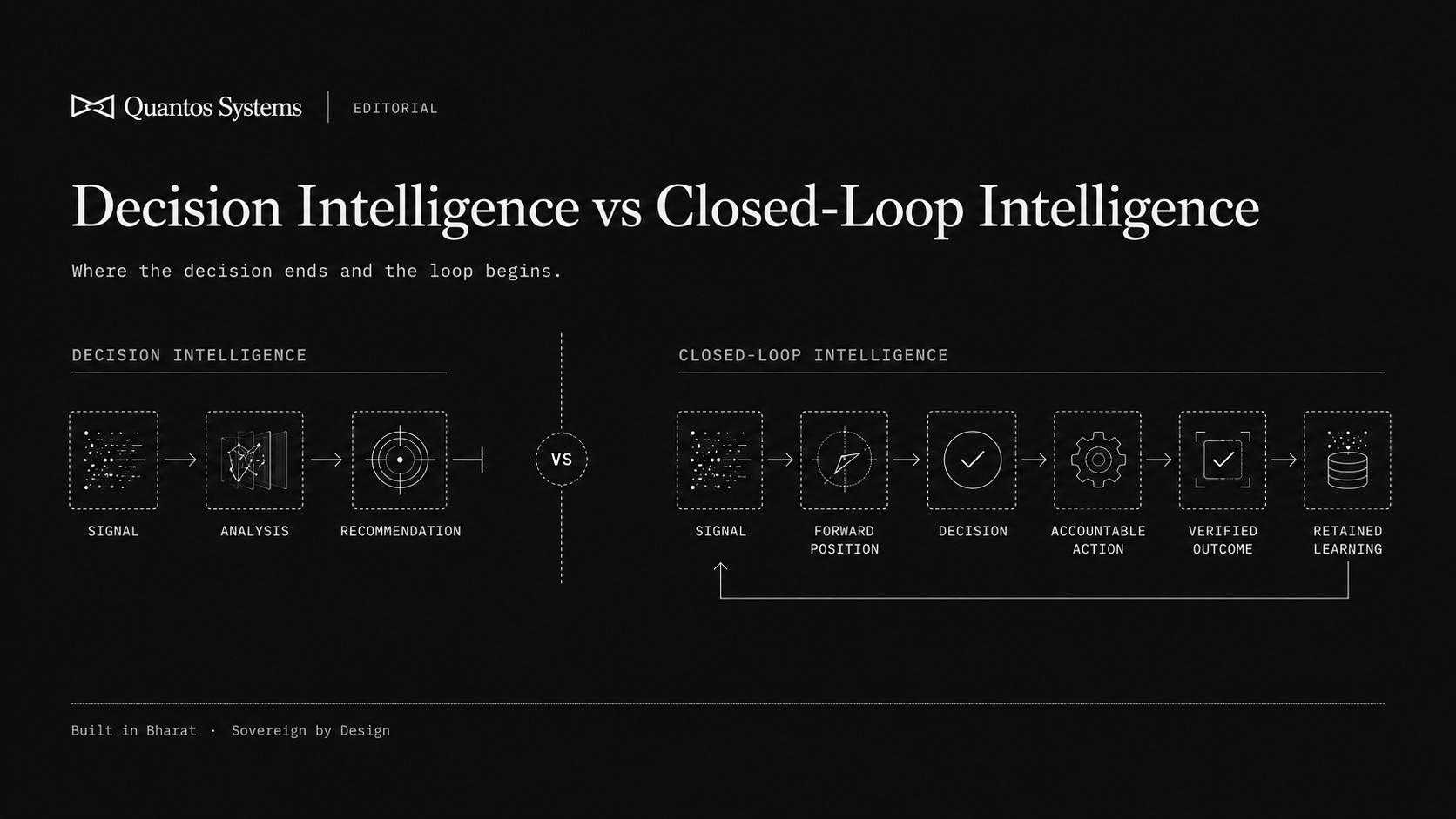
Decision intelligence helps an enterprise make better decisions. Closed-Loop Intelligence ensures that the decision travels through accountable action, verified outcome and retained learning.
The difference is not semantic. It determines whether intelligence merely informs the institution or permanently improves how the institution operates.
What is decision intelligence?
Decision intelligence combines data, analytics, rules, models and operational context to support or automate decision-making.
A decision-intelligence platform may help an organisation:
- Understand what is happening.
- Predict what may happen next.
- Compare available choices.
- Recommend an appropriate response.
- Support a human decision-maker.
- Automate defined decisions under approved rules.
This is an important advance beyond traditional business intelligence. Dashboards describe the past and present. Decision intelligence attempts to connect that information to a decision.
But producing a decision or recommendation does not necessarily complete the operational cycle.
A recommendation can still remain unactioned. An action can be assigned without being completed. A completed action can fail to produce the expected outcome. Even when the outcome is known, the reasoning may not be retained for the next cycle.
The decision may be intelligent while the institutional loop remains open.
What is Closed-Loop Intelligence?
Closed-Loop Intelligence is an intelligence system that carries a signal through the complete operational cycle:
Signal → Forward position → Priced consequence → Governed decision → Accountable action → Verified outcome → Retained learning
It does not stop after identifying a risk or recommending a response.
The system continues until it can establish:
- What action was authorised?
- Who became accountable for it?
- Was the action completed?
- Did it produce the expected result?
- What changed between the forecast and the outcome?
- What must the institution remember for the next decision?
The outcome returns to the beginning of the system. It becomes part of the reasoning applied when the next signal arrives.
That returning outcome is what closes the loop.
Decision support is not loop closure
Many enterprise systems can detect a problem.
They can report falling inventory, delayed procurement, deteriorating cash flow, production constraints, service failures or readiness gaps. More advanced systems can predict the likely consequence and recommend an intervention.
The operational failure often begins after that point.
A person exports the report. Another person sends an email. A meeting assigns responsibility. The corrective action moves into a separate workflow. Its eventual outcome may be recorded elsewhere—or not recorded at all.
The system that produced the intelligence cannot reliably answer whether its recommendation was accepted, executed or effective.
The intelligence has crossed into a human handoff and lost continuity.
Closed-Loop Intelligence removes that structural break without removing human authority.
Human authority remains
Closing the loop does not mean allowing software to make every consequential decision.
The accountable executive, officer or institutional authority continues to decide where human judgement is required.
The system’s responsibility is different. It preserves the complete chain surrounding that authority:
- The evidence available at the time.
- The projected consequence of acting or not acting.
- The options considered.
- The authorised decision.
- The person responsible for execution.
- The result produced.
- The difference between expectation and reality.
- The lesson carried into the next cycle.
This creates governed intelligence rather than uncontrolled automation.
The practical difference
Consider a critical material shortage.
A reporting system shows the current stock.
A predictive system estimates when the stock may run out.
A decision-intelligence system may recommend a replenishment action after considering demand, supply and cost.
A Closed-Loop Intelligence System continues further. It prices the consequence of the shortage, places the authorised correction with an accountable owner, verifies whether replenishment occurred, measures whether readiness actually improved and retains the result for the next forecast.
The distinction can be stated simply:
Decision intelligence improves the decision. Closed-Loop Intelligence governs the complete life of the decision.
Why existing systems leave the loop open
ERP, CRM, planning, analytics and workflow systems remain essential. They hold transactions, customers, inventory, plans, approvals and operational activity.
They were built for specific responsibilities.
A system of record records. A dashboard displays. A planning system plans. A workflow system routes. A predictive model forecasts.
The missing layer is the one that reasons across these systems and remains responsible for the full cycle from signal to institutional learning.
Closed-Loop Intelligence operates above existing systems. It does not require the enterprise to discard the infrastructure it already trusts.
Closed-loop intelligence and enterprise planning
Enterprise planning platforms coordinate demand, supply, finance, inventory and operational plans. They help organisations model scenarios and align resources.
Closed-Loop Intelligence addresses a broader institutional problem: whether a consequential signal becomes a governed correction whose outcome improves the next decision.
Planning may form part of the loop. It is not automatically the entire loop.
A plan becomes closed-loop intelligence only when the institution can connect the original signal, forecast, decision, accountable action, measured outcome and retained learning as one continuous position.
Closed-loop intelligence and operational intelligence
Operational intelligence provides timely visibility into events and conditions across an organisation.
Visibility is necessary, but visibility alone does not create correction.
An institution may see the problem clearly and still fail to act before the consequence becomes binding. Closed-Loop Intelligence converts operational visibility into an accountable and verifiable correction cycle.
Closed-loop intelligence and artificial intelligence
Artificial intelligence can detect patterns, generate forecasts and propose actions. These capabilities can contribute to a closed loop, but an AI model is not itself a Closed-Loop Intelligence System.
The institutional requirements remain:
- Governed authority.
- Reproducible reasoning.
- Accountable ownership.
- Outcome verification.
- Auditability.
- Retained learning.
- Control over data and deployment.
In regulated, sovereign or high-consequence environments, the method of reaching an answer matters as much as the answer itself.
Why the distinction matters
An open loop repeatedly pays for the same lesson.
The institution detects a familiar problem, reconstructs the reasoning, identifies an owner and attempts another correction. When the people involved move roles or leave, much of the judgement leaves with them.
A closed loop retains that judgement institutionally.
Over time, the system does more than produce isolated recommendations. It preserves why decisions were made, measures what followed and improves the reasoning available to the next authorised decision-maker.
That is the difference between generating intelligence and building an institution that learns.
Where Quantos fits
Quantos is not another dashboard, reporting layer or generic decision-intelligence tool.
Quantos is a Closed-Loop Intelligence System designed to operate above the systems an enterprise, defence organisation or institution already runs.
It carries governed intelligence from operational signal to forward consequence, accountable correction, verified outcome and retained learning.
Existing systems remain. Human authority remains. The loop stops remaining open.
Frequently asked questions
Is Closed-Loop Intelligence the same as decision intelligence?
No. Decision intelligence focuses on improving or automating decisions. Closed-Loop Intelligence carries the decision through accountable execution, outcome verification and retained learning.
Does Closed-Loop Intelligence replace ERP or planning software?
No. It operates above existing systems of record, planning platforms, operational databases and approved workflows.
Is Closed-Loop Intelligence fully autonomous?
Not necessarily. Human authority can remain mandatory for consequential decisions. Closing the loop means preserving and governing the complete cycle, not removing authorised human judgement.
What makes an intelligence loop closed?
The loop is closed when the verified outcome returns to the system and changes the reasoning available for the next decision.
What problem does Closed-Loop Intelligence solve?
It closes the structural gap between knowing, deciding, acting, verifying and learning—a gap that conventional enterprise systems frequently divide across different tools and people.
Can Closed-Loop Intelligence work in defence and sovereign environments?
Yes, when deployed under the institution’s required infrastructure, governance, security and authority model. Sovereign environments require control over operational data, reasoning, deployment and auditability.
The final distinction
Decision intelligence asks:
What should we decide?
Closed-Loop Intelligence continues:
What was decided, who acted, what happened, what did the institution learn, and how will that change the next decision?
A decision is a moment.
Intelligence becomes institutional only when the loop closes.