Offerings / Industries

Quantos for Hospitality

A hotel can sell out and still lose money. The two decisions that actually determine profit the rate you set, and the cost that rate triggers in labour, F&B and service are made by different people, on different logic, and they never meet until the month-end P&L, when the money is already spent. Every system you run sits on one side of that gap. Revenue tools price the room. Labour tools staff it. None of them connects the two, which is the only place profit actually lives. Quantos is the one loop that closes it before the room is sold, across every property as one.

See the decision your systems never join
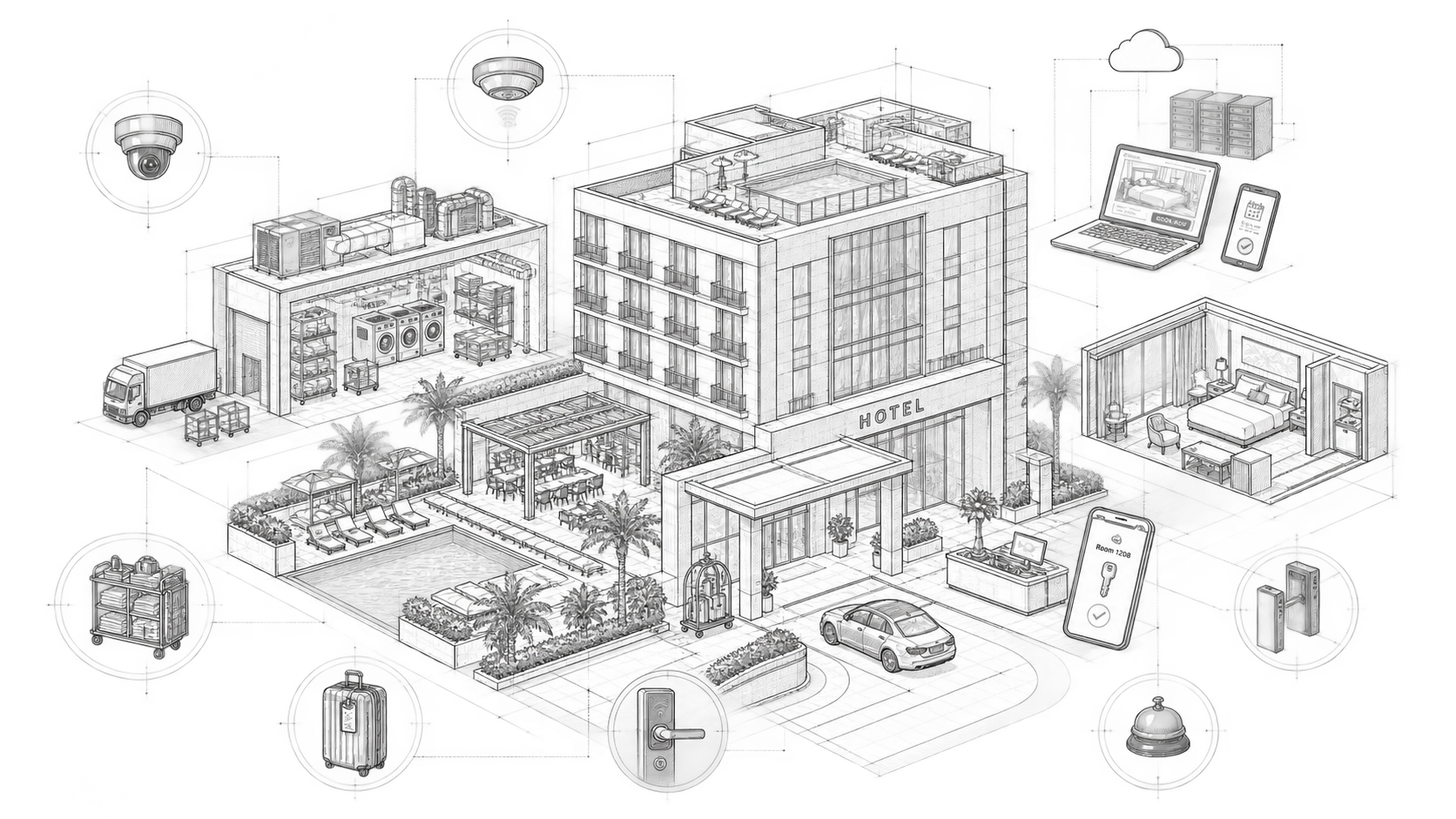
Hospitality operations shown in monochrome technical linework

The operating reality

You are not optimising profit. You are optimising half of it.

Hospitality has spent a decade optimising the wrong number. Occupancy and RevPAR say the hotel is full; they say nothing about whether it is profitable. A filled room activates variable cost housekeeping, F&B, utilities, overtime that a rate increase never does. Sell the room at the wrong price and every occupied night costs you, and you find out at month-end, from the P&L, not the booking calendar.

The reason is structural, and the industry names it plainly: revenue and cost are run in parallel, by different teams, and the decisions governing each rarely intersect before the financial result arrives. Pricing responds to demand and the competitor set. Labour, channel-mix cost and F&B obligations follow their own logic entirely. The two halves of every profit decision are made in separate rooms and reconciled in a third, weeks after the guest has checked out.

None of this is a failure of the people setting rates or building rosters. It is the structural default of an industry whose tools were built for one side of the equation at a time. The revenue system was never built to see the cost its price would trigger. The labour system was never built to see the rate that justified its staffing. And no system was ever built to close the loop between them, decide while it still matters, and keep the reasoning when the person who understood the trade moves on.

Where the real margin is won or lost

The calls that decide GOP, made on half the picture.

The full house that loses money on every key

Occupancy hits target and the P&L still compresses, because the rate was set blind to the cost it activated. Volume looks like success on the booking calendar and reads as a loss on GOPPAR. Nobody connected the two before the rooms were sold, and nobody scored the trade after.

Labour set to a demand that did not arrive

Staffing is built to an occupancy forecast, then demand softens or the mix shifts, and the roster carries a cost the revenue never covered. The single largest controllable line in the business is committed days ahead, against a picture that has already moved, with no loop to adjust it while it still matters.

Rate cut to fill rooms that erode the brand and the margin

A soft period triggers a discount to protect occupancy, and the discount protects the wrong number filling rooms at a rate below the cost they carry, while training the market to wait for the drop. The decision to hold or cut had a window, and no forward view of its cost consequence to make it on.

F&B and events priced blind to the cost they carry

A banquet is won on a headline rate, a menu is set on covers, an event is booked on the room hire and the labour, kitchen input and setup cost each one triggers is decided somewhere else, later. F&B and events are the highest-swing margin in the property, and they are run as two separate bets: the price in one room, the cost in another, the profit discovered when the function is already over.

A portfolio seen only once the quarter is closed

Ownership sees the estate as one picture at month-end, in arrears, when every rate and roster decision that picture would have informed is already made. The portfolio is run on a rear-view of itself precise about last month, blind to the position it holds tonight.

These are not five problems for five tools. They are one failure a profit decision split in half and joined too late surfacing across rate, labour, discount, F&B, events and portfolio at once. No single desk sees both halves, and no system in the building was ever built to.

The property operating model

One loop that joins price and cost and keeps thinking after the decision.

Every system a hotel runs today is a rear-view mirror sold as a windshield. It records what each side did, with precision, and goes dark at the moment the two sides needed to be one decision. Quantos is not that. It is an enterprise-grade, multi-tenant closed-loop intelligence system, and the loop does not break at the point a person takes over which is the exact point every other tool fails.

It reads the property as one position rate, demand, labour, F&B and margin connected, not two teams optimising two numbers that only meet in arrears. It surfaces the forward trade in money and days while the rate and the roster can still be changed: sell this room at this price and here is the cost it triggers, here is the margin that survives, here is why the call has to be made now. That reasoning goes to an accountable owner with the evidence attached, and then the loop stays in the room. It checks what the trade actually produced. It scores its own call against the P&L it predicted. It keeps that record permanently and in an industry where revenue managers and general managers move every couple of years, that permanence is not a detail. Today, when a strong operator leaves, the feel for this property’s demand the instinct for when to hold rate and when to staff up walks out with them, and the next hire rebuilds it from nothing over a year of expensive mistakes. Quantos keeps the reasoning as the institution’s, not the individual’s. The property does not forget what it learned the day the person who learned it resigns.

This is not a revenue-management system, a labour tool or a better dashboard. Those optimise one half and stop. Quantos decides on the whole, proves it and improves across every property in the portfolio as one. The industry has been perfecting the price of a room for twenty years. Quantos closes the loop on the profit of it.

Evidence from your own property portfolio

The profit you booked, against the profit the trade could have held.

Read the incumbents’ own words. A revenue system promises to optimise rate against demand. A labour system promises to match staffing to occupancy. Each is excellent at one half of the decision and blind to the other, and each hands its number to a person who then reconciles it, weeks later, in a P&L. None of them checks whether the price and the cost it triggered actually made money together. None of them closes the loop because none of them was built to hold both halves at once.

Quantos holds the rate it recommended, the cost that rate would trigger, whether the operator followed it, and what the trade then produced across every property. So it can show the one thing no revenue or labour tool can: the profit the portfolio actually booked, against the profit it would have held had every call been made on both halves together. The distance between them is the margin split-thinking left on the table, drawn in the operator’s own money not an estimate, not a benchmark, the profit that was really lost between two rooms deciding two numbers.

And the shape matters as much as the size. The gap widens. A room sold below its triggered cost, a roster held against demand that moved, a discount that trained the market each is not a one-time miss but a leak that opens further every period the loop stays open, because the trade no one scored is the trade the portfolio repeats next season. Quantos holds one discipline here without exception: the gap is shown, not filled. It never invents a flattering version of the operator’s history. It shows, with evidence, the profit that was really there to hold because on a hotel’s margin, an answer you can audit is the only one worth moving rate or labour on.

Proof on your own portfolio, not a projection

We do not ask you to trust a forecast. We replay your last year, across every property.

A forecast is a claim about a future you can argue with. Quantos offers something no argument survives: your own portfolio’s history, replayed. Run the loop backward across the year the estate has already lived, and watch every call it would have made appear in sequence the full house flagged as unprofitable before the rate was published, the roster caught before it was committed against demand that fell, the discount named as a loss before it trained the market. Each one timestamped ahead of the result it saw coming, and each one seen across the whole portfolio rather than one property at a time.

This is not a demonstration built on our data. It is built on yours, and it settles the only question ownership actually asks: not “can this system price,” but “would it have been right on my properties, in my year, on the full nights that still lost money.” The loop scores itself against the P&L that truly landed, in the open, and lets the operator judge the record before it ever depends on it. No other system can offer that, because no other system held both halves of the decision long enough to have the record.

Where Quantos sits

Your systems remain. Quantos closes the loop above them.

Quantos does not ask a hotel operator to replace anything. The property management system, the revenue-management system, the labour and finance platforms at every property they stay, and they stay the systems of record. They were built to price rooms, build rosters and report results, and they do it well. What they were never built to do is hold both halves of the profit decision at once and carry it forward: to price the room against the cost it triggers, decide while it still matters, measure the outcome, score the call, and keep the intelligence when a person leaves.

That layer has simply never existed. It exists now, it is the only thing Quantos adds, and it is deterministic, governed and evidenced end to end no black box, no fabricated output. It sits above the stack you already own, works from the data you already approve, and closes the loop those systems leave open between the rate and its cost. You keep everything you have built and gain the layer that makes a portfolio decide profit as one operation instead of a dozen properties optimising half of it.

For the people who own the number

What operators and owners ask first.

Is this a revenue-management or pricing system?

No. Revenue tools optimise price on one side of the decision and stop. Quantos closes the loop between the rate you set and the cost it triggers in labour, F&B and service surfaces the trade forward, drives the decision, scores it against the P&L and corrects the next. Pricing is one signal in the loop, not the loop.

Why does a full hotel still lose money?

A filled room activates variable cost a rate increase does not. When price and cost are decided separately and only meet at month-end, you can sell out at the wrong price and find the loss after it is booked. Quantos joins the two before the room is sold, in money and days.

Can it run across our whole portfolio?

Yes. Quantos is enterprise-grade and multi-tenant built to run many properties as one. Each property keeps its own reality; ownership finally sees the portfolio whole, on one loop, instead of a set of P&Ls reconciled after the quarter.

How do we move rate or labour on a call we cannot see inside?

You do not have to. Quantos is deterministic every call traceable to its evidence, reproducible, governed. No black box, no hallucination. On a hotel’s margin, an answer you can audit is the only one worth acting on.

Quantos Systems · Hospitality

Every loss sent a signal first.Nothing was built to act on it.Now something is.