A car is thousands of parts that must all arrive, in sequence, at the same moment and it cannot be sold missing one. That single fact gives the automotive supply chain the most brutal leverage ratio in industry: a component worth a few dollars, constrained three tiers down where no one at the OEM can see it, stops a line and makes thousands of finished vehicles worth lakhs each undeliverable. The chain is synchronised down to the hour, but it is not sighted the manufacturer plans against its first tier, while the constraint that will halt production forms two or three tiers below, in a casting, a magnet, a cell, a chip the semiconductor industry has quietly redirected to a higher-margin buyer. And all of it is happening while the chain itself is being rewired for the shift to electric. Quantos is the one loop that closes the distance between the deep-tier signal and the plan before one missing part becomes a stopped plant.

See the plant one part could stop
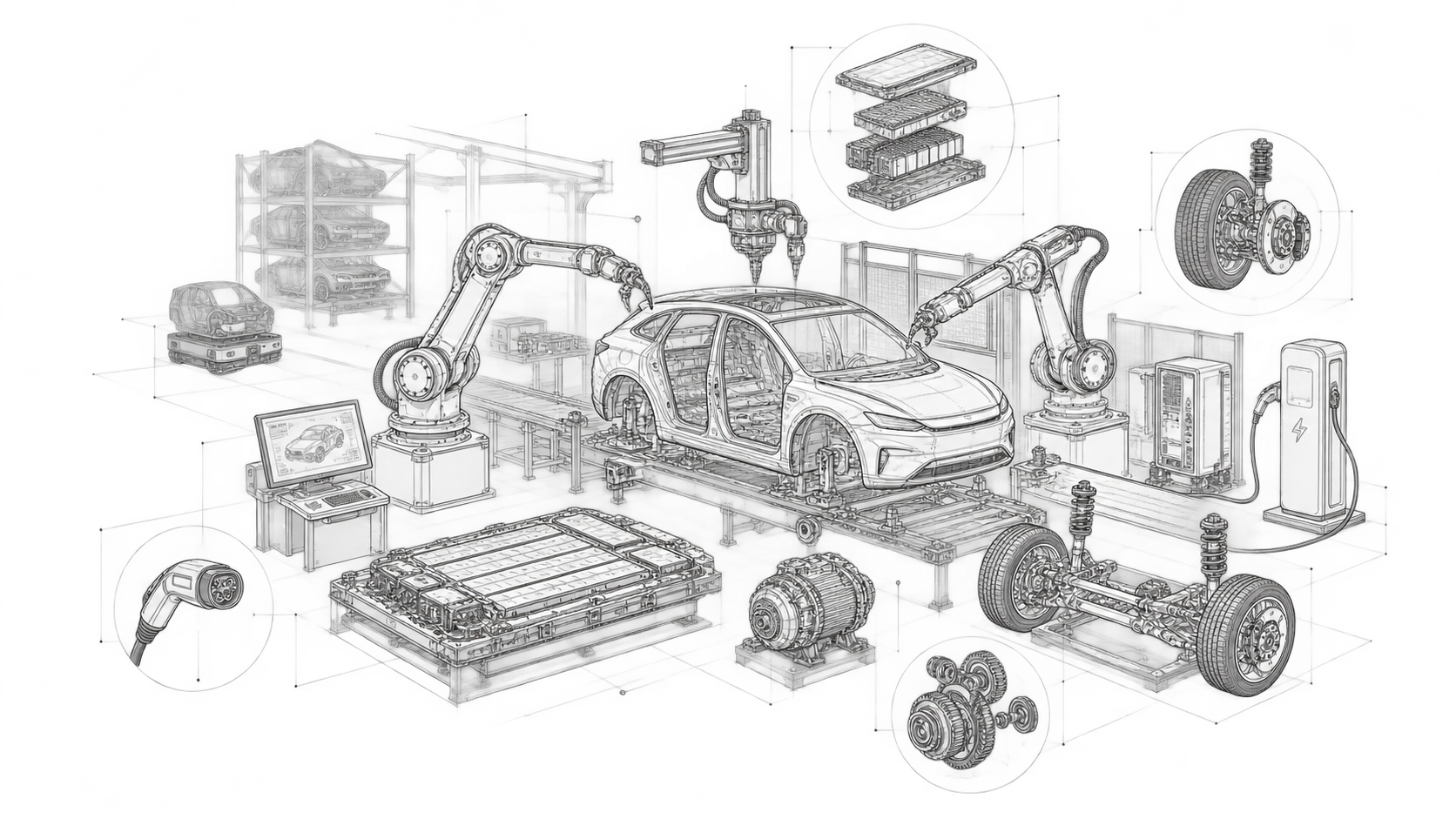
Automotive vehicle and major components shown in technical X-ray linework

The operating reality

Synchronised to the hour, sighted only to the first tier.

Automotive perfected the synchronised supply chain just-in-time, lean, thousands of parts arriving at the line in the exact sequence the build requires. It is one of the great feats of industrial coordination, and it has one fatal property: it has almost no slack. A vehicle is not shippable until every part is present, so the chain runs at the pace of its most constrained component, and a single shortage anywhere in it stops everything downstream. The same discipline that makes the chain efficient makes it brittle.

And the brittleness sits where the OEM cannot see it. A manufacturer has clear sight of its first-tier suppliers and the orders it places with them. It has far less sight of the tier below that, and almost none of the tier below that where the specialty casting, the rare-earth magnet, the battery cell, the automotive-grade chip actually originates. When capacity three tiers down is quietly reallocated to a higher-margin buyer, or a single-source component hits a constraint, the signal is real and present in the chain long before it reaches the line. It simply is not visible to the system that plans production.

None of this is a failure of the buyers, the planners or the plant. It is the structural default of an industry whose systems see one tier or one plant at a time, and reconcile the whole only when the line has already stopped and it is being tested harder than ever, because the chain is being rewired for the electric transition at the same time, with new dependencies on cells and semiconductors and new obsolescence risk in everything built for the old powertrain. The constraint forms deep, the plan is committed shallow, and no system closes the loop between the signal forming three tiers down and the production decision while there is still time to change it.

Where plan attainment and margin are won or lost

The calls that decide the line, made without seeing the tier that stops it.

The line stopped by a part no one was watching

A component three tiers down hits a constraint, and the first the OEM knows of it is a tier-one supplier missing a delivery by which point the line is days from stopping and the substitute is months away. The signal existed deep in the chain while there was still time to resource, re-sequence or pre-buy. Nothing connected it to the production plan while the plan could still move.

The chip capacity reallocated to a buyer who pays more

Automotive-grade silicon competes for capacity with buyers who command higher margins, and a foundry’s quiet reprioritisation shows up as a shortage the auto planner never saw being decided. The exposure formed in someone else’s allocation meeting; the OEM inherits it at the line. The window to secure supply or redesign around it was open before the shortage was visible.

The plan built for a demand mix that shifted under the transition

Production is committed to a forecast of the ICE-to-EV mix, and the mix moves a variant sells faster, an incentive changes, a segment cools. The plant is tooled and the parts are ordered for the mix that was assumed, stranding inventory on one side and starving the line on the other. The demand signal and the sourcing commitment live in systems that meet at the month, not the moment.

A chain seen only when the line has already stopped

Leadership sees plan attainment, days-of-cover and line-stop cost in the review, in arrears, when every sourcing, production and inventory decision that picture would have informed is already made or missed. The chain is run on a rear-view of itself precise about last month’s stoppage, blind to the constraint forming three tiers down right now.

These are not four problems for four tools. They are one failure a chain synchronised to the hour but sighted only to the first tier surfacing across supply, capacity, demand mix and line attainment at once. No single system sees the constraint from the deep tier to the line, and none of them was ever built to.

What Quantos is

One loop from the deepest tier to the line closing the gap the chain hides.

Existing operating estateSystems remain authoritative
ERPMESSCM / planningSupplier portals

Each system governs its own operational layer and retains its role as a system of record.

Governed connection

Closed-loop intelligence

One live chain the deep-tier constraint surfaced while the plan and sourcing can still changeQuantos connects the sub-tier signal, accountable decision and line outcome as one governed record.
Existing systems stay in placeDeep-tier signal → decision → line outcome

Every system a manufacturer runs today sees one layer of the chain. The ERP records the transactions. The MES runs the plant. The planning suite schedules the build against the demand forecast. The supplier portal shows the first tier. Each is excellent at its layer, and each hands its number to a person who is looking at the tier above the one where the problem is forming. They record the order and schedule the line; not one of them closes the loop between the constraint forming three tiers down and the production decision that could still absorb it.

Quantos is that loop. It sits above the stack you already run and reads the chain as one live position demand, plan, tier-one through tier-three supply, capacity and inventory connected, not a planning suite and a supplier portal that meet when the line stops. It carries the forward exposure of a deep-tier signal to the moment it would hit the line: this component is constraining three tiers down, it stops this line in this window and strands this much finished value here is the resource, the re-sequence or the pre-buy that holds the plan, here is why it has to be made now. It hands that call, with the evidence, to the accountable owner and where the decision touches safety, homologation or quality, it stays with the OEM’s qualified authority. It watches what the line then did. It scores its own call against plan attainment. It learns how a deep-tier signal turns into a stoppage. And it corrects the next cycle, so the plan you commit shallow is protected by the signals forming deep.

This is not a better ERP, a smarter MES or another planning dashboard it is not an automotive point-solution at all. It is a deterministic closed-loop intelligence system, and automotive is simply the environment where the leverage of one missing part is highest and the constraint hides deepest. Those systems record the order and run the plant, and stop. Quantos decides, proves and improves across the OEM, the tiers and the plants as one. The industry has spent a decade getting better at scheduling the line. Quantos closes the loop that keeps it running.

The proof no competitor can draw

The attainment you held, against the attainment the loop would have protected.

Read the incumbents’ own words. An ERP records the order. An MES runs the plant. A planning suite schedules the build. A supplier portal shows tier one. Every one of them ends at the same place: a record, a schedule, or a status, handed to a person looking one tier above where the constraint is forming. None of them checks whether the sourcing call held the line, scores itself against plan attainment, or corrects the next plan. None of them closes the loop because none of them holds the chain from the deepest tier to the line as one.

Quantos holds the deep-tier signal it flagged, the sourcing or production call it recommended, whether the manufacturer acted, and what the line then did. So it can show the one thing no ERP or planning system can: the plan attainment and the value the chain actually held, against the attainment and value it would have held had every deep-tier signal been acted on while the plan could still change. The distance between them is the production the open loop let stop the lines halted, the finished value stranded, the expedite premiums paid drawn in the manufacturer’s own units and money, not an estimate, not a benchmark, the attainment that was really there and really protectable.

And the shape is the whole leverage of a synchronised chain. The gap widens, because a deep-tier signal missed once is not one stoppage it is the same blind spot, repeating across every component single-sourced beyond the first tier, on a chain being rewired for the transition while it runs. Quantos holds one discipline here without exception: the gap is shown, not filled. It never invents a flattering version of the chain’s history. It shows, with evidence, the attainment that was truly there to hold because when one part stops a plant, a decision you can audit is the only one worth acting on.

Why this cannot be answered by a better planning suite

Three things no rear-view system can do, at any price.

It draws the world that did not happen

Because Quantos alone holds the signal it flagged, whether you acted on it and what the line then did, it can show the plan attainment you would have held had every deep-tier signal been acted on against what the chain actually produced. No ERP, no MES, no planning suite can draw that line, because none of them carries the outcome of its own advice. It is the one view in the chain a competitor cannot copy, because copying it means closing the loop, and they have not.

It keeps a scored record of every call it ever made

Every deep-tier signal, every sourcing and production call, and whether it held the line, kept permanently a provable track record of the system’s own judgement, cycle after cycle. Not a review deck that is filed and forgotten, but an accumulating body of evidence that says, in your own attainment, here is what we called and here is how the line ran. No planning system can produce it, because none of them ever kept the score of its own decisions.

It is the only system that gets better as the chain gets harder

Your ERP and planning tools are exactly as good today as the day they were configured, while the chain they schedule grows more complex every year with the electric transition. Quantos moves the other way. Every cycle it scores its own call, learns how a deep-tier signal turns into a stoppage and sharpens the next plan so the attainment it protects this quarter survives constraints the one last quarter would have missed. It compounds. A rear-view system decays against a rewiring chain. Quantos improves against it.

This is why Quantos is not a better automotive tool. It is a different category of enterprise intelligence a deterministic closed loop that decides, proves and improves and a supply chain is simply where the loop it closes turns one missing part back into thousands of finished vehicles.

Proof on your own chain, not a projection

We do not ask you to trust a forecast. We replay your last year, line by line.

A forecast is a claim about a future you can argue with. Quantos offers something no argument survives: your own chain’s history, replayed. Run the loop backward across the year the plant has already built, and watch every call it would have made appear in sequence the deep-tier constraint flagged before it reached tier one; the chip shortage named before it stopped the line; the demand-mix shift caught before the parts were committed to the wrong variant. Each one timestamped ahead of the stoppage it saw coming.

This is not a demonstration built on our data. It is built on yours, and it settles the only question a manufacturing head actually asks: not “can this system schedule,” but “would it have held the line on my chain, on the part that actually stopped the plant.” The loop scores itself against the plan attainment that truly landed, in the open, and lets you judge the record before you ever run the chain on it. No other system can offer that, because no other system held the chain from the deepest tier to the line as one long enough to have the record.

Where Quantos sits

Your systems remain. Quantos closes the loop above them.

Quantos does not ask a manufacturer to replace anything. The ERP, the MES, the SCM and planning suites, the supplier portals and quality systems they stay, and they stay the systems of record. They were built to record, run, schedule and report, and they do it well. And the decisions that must stay with the OEM’s qualified people safety, homologation, quality determination remain entirely with their authorised authority. Quantos surfaces and governs; it does not take those calls.

What the existing stack was never built to do is hold the chain from the deepest tier to the line as one and carry the decision forward: to connect the sub-tier signal to the production and sourcing decision, decide while the plan can still change, measure the line outcome, score the call, and keep the lesson when a planner leaves. That layer has simply never existed. It exists now, it is the only thing Quantos adds, and it is deterministic, governed and evidenced end to end no black box, no fabricated output. The manufacturer keeps everything it has built and gains the layer that sees the constraint before it becomes the stoppage.

For the people who own plan attainment

What automotive leadership asks first.

Is this an ERP, MES or planning system?

No. Those record, run and schedule, each sighted to its own tier. Quantos closes the loop across them connects the deep-tier constraint to the production and sourcing decision to the line outcome, surfaces the forward exposure in units and money while the plan can still change, drives the decision, scores it and corrects the next cycle. Recording and scheduling are where they end. It is where Quantos begins.

Why does one missing part stop thousands of vehicles?

Because a vehicle is a synchronised assembly of thousands of parts and cannot ship incomplete. One constrained component a chip, a casting, a magnet, a cell halts the whole line, and the OEM sees its first tier while the constraint forms two or three tiers down. Quantos closes the loop between the deep-tier signal and the plan.

Can it run across the OEM, the tiers and our plants?

Yes. Quantos is enterprise-grade and multi-tenant built to run the OEM, its supplier tiers and every plant as one forward position, not systems reconciled after the line stops. Each entity keeps its reality; the manufacturer finally sees the constraint, the plan and the delivery on one loop.

How do we act on a call we cannot see inside?

You do not have to. Quantos is deterministic every call traceable to its evidence, reproducible, governed, and safety, homologation and quality left with the OEM’s qualified authority. No black box, no hallucination. When one part stops a plant, a decision you can audit is the only one worth acting on.

Quantos Systems · Automotive

Every loss sent a signal first.Nothing was built to act on it.Now something is.