Offerings / Industries

Quantos for Ports & Shipping

A port looks like one operation but is really a chain of tightly coupled interfaces berth, crane, yard, gate, rail, road and it runs with almost no slack. That is what makes it fast when it works and brittle when it does not: a constraint at any single interface backs up every one behind it. A ship can berth exactly on schedule and still have its containers sit in the terminal for days because the yard is full, the customs hold is pending, or no trailer or rail rake is there to move the box inland. And once one interface chokes, the backlog cascades vessel queues build, dwell time stretches, demurrage accrues, and carriers start diverting to other terminals, spreading the disruption further. External shocks monsoon, a cargo surge, a Red Sea diversion hit this system with no buffer to absorb them. Quantos is the one loop that closes the distance between the cascade signal and the decision before the chokepoint tips.

See the queue one interface can start
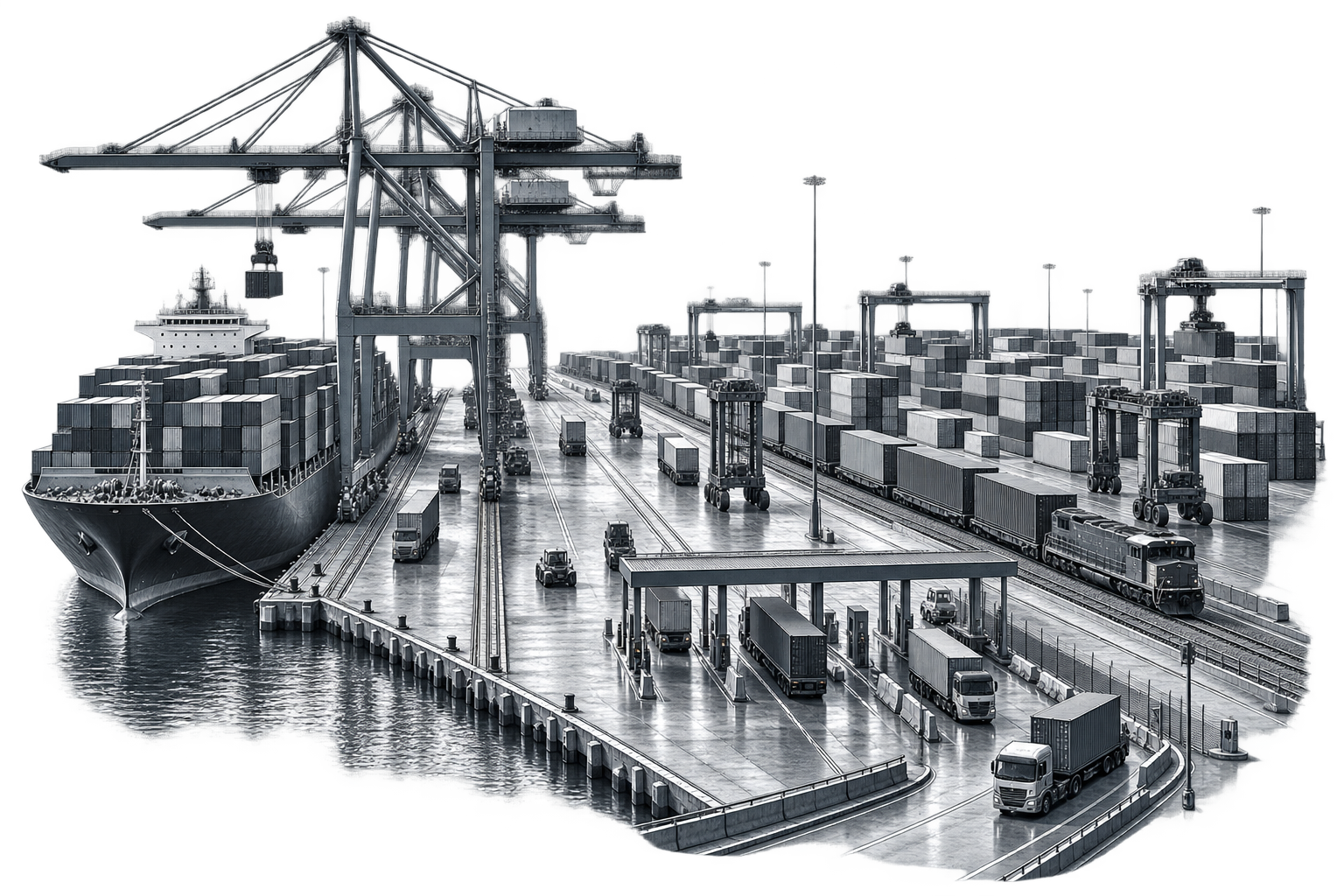
A connected port operation spanning vessel, berth, cranes, yard, gate, rail and road

The operating reality

A chain of interfaces with no slack, where one delay backs up all the rest.

A port’s throughput is not set by its biggest crane or its deepest berth. It is set by whichever interface is most constrained at that moment, because the interfaces are physically coupled and none of them has spare capacity to absorb a shock from the one before it. The berth feeds the crane, the crane feeds the yard, the yard feeds the gate, the gate feeds the rail and the road. When any one of them slows, everything upstream of it has nowhere to go, and the delay propagates backward through the whole chain.

That is why a port can look fine on one measure and be failing on another. Vessel turnaround can be at its best-ever number while containers pile up in the yard because the hinterland cannot clear them a ship berths on time, and its boxes still sit for a week because there is no trailer, no rake, or no yard space to receive them. The constraint that matters is rarely the one being watched, and by the time it shows up as a queue of waiting vessels or a demurrage bill, it has already cascaded through several interfaces that each looked acceptable on their own.

None of this is a failure of the terminal operators, the yard planners or the port authority. It is the structural default of an industry whose systems run the terminal in one place, connect the community in another, track the vessels in a third and clear the hinterland in a fourth and reconcile the whole into turnaround and dwell only after the queue has formed. And it is being tested harder than ever, as diverted cargo, equipment imbalances and weather arrive without warning at a system with no slack. The signal of a cascade forming exists at the choking interface before it becomes a queue; no system closes the loop between that signal and the decision while there is still time to prevent it.

Where turnaround and demurrage are won or lost

The calls that decide the queue, made after the cascade starts.

The berth allocated into a yard that could not receive it

A vessel is berthed and worked on schedule, but the yard behind it is already filling and the hinterland cannot clear the boxes, so the containers strand and the next vessel queues. The berth decision was made on the berth’s own state, blind to the yard and gate constraint forming behind it. The signal that the yard would choke was there before the box landed; nothing connected it to the berthing call.

The rail and road interface that let the yard back up

The yard clears only as fast as the hinterland takes it away, and a shortage of rakes or trailers turns a working terminal into a full one within hours. The box arrives, the ship leaves, and the container sits because the interface inland failed. The signal that the evacuation was falling behind the intake formed before the yard filled; nothing matched the two in time to act.

The diversion decided too late, after the queue had formed

When a terminal congests, carriers divert to another, but the diversion is a reaction to a queue that has already built and it spreads the density to the next terminal instead of preventing it. Decided while the cascade was still forming, the same reallocation would have held the schedule. The window to divert early closed while the congestion was still invisible in the aggregate.

A port seen only when turnaround and demurrage are counted

Leadership sees turnaround, dwell and demurrage in the report, in arrears, when every berth, yard, gate and diversion decision that picture would have informed is already made. The port is run on a rear-view of itself precise about last week’s congestion, blind to the cascade forming at an interface right now.

These are not four problems for four tools. They are one failure a chain of coupled interfaces with no slack, where a delay at one cascades into all surfacing across berth, yard, gate and schedule at once. No single system sees the cascade from the choking interface to the vessel queue, and none of them was ever built to.

What Quantos is

One loop across every interface closing the gap before the cascade forms.

Every system a port runs today holds one interface. The terminal operating system runs the terminal. The port community system connects the parties. The vessel traffic system tracks the ships. The ERP and the hinterland systems handle the inland leg. Each is excellent at its interface, and each hands its number to a person after the delay it holds has already begun to cascade. They run the terminal and track the vessel; not one of them closes the loop between the constraint forming at one interface and the decision that could still stop it spreading to the rest.

Quantos is that loop. It sits above the stack you already run and reads the port as one live position vessels, berth, crane, yard, gate, rail and road connected, not a terminal system and a hinterland system that meet after the queue. It carries the forward consequence of a cascade to the moment it would land: this yard is filling faster than the hinterland can clear it, this berthing will strand boxes the gate cannot move, this terminal is heading for a queue that an early diversion would prevent here is the decision, here is the turnaround and demurrage it protects, here is why it has to be made now, before the cascade. It hands that call, with the evidence, to the accountable owner and where the decision is vessel traffic, navigation or marine safety, it stays with the port and maritime authority; Quantos does not direct the ships. It watches what then happened. It scores its own call against the turnaround and the dwell. It learns how a signal at one interface turns into a queue across all. And it corrects the next cycle, so the port you run is sharper against the next cascade than it was against the last.

This is not a better TOS, a smarter PCS or another vessel tracker it is not a port point-solution at all. It is a deterministic closed-loop intelligence system, and a port is simply the environment where the interfaces are most tightly coupled and the slack to absorb a shock is smallest. Those systems run the terminal and track the vessel, and stop. Quantos decides, proves and improves across every interface as one. The industry has spent a decade getting better at running each interface. Quantos closes the loop between them.

The proof no competitor can draw

The turnaround you held, against what the loop would have protected.

Read the incumbents’ own words. A TOS runs the terminal. A PCS connects the community. A VTMS tracks the vessels. An ERP handles the hinterland. Every one of them ends at the same place: a terminal state, a message, a track, or a number, handed to a person after the delay it holds has already started to spread. None of them checks whether the berth, yard or diversion call held the turnaround, scores itself against the dwell and demurrage, or corrects the next cycle. None of them closes the loop because none of them holds the port from the choking interface to the vessel queue as one.

Quantos holds the cascade signal it flagged, the berth, yard, gate or diversion call it recommended, whether the port acted, and what then happened. So it can show the one thing no terminal or vessel system can: the turnaround and the demurrage the port actually carried, against the turnaround and demurrage it would have carried had every cascade been acted on while the queue could still be prevented. The distance between them is the throughput the open loop let choke the vessels queued, the dwell stretched, the demurrage accrued drawn in the port’s own hours and money, not an estimate, not a benchmark, the performance that was really there and really protectable.

And the shape is the whole fragility of a chain with no slack. The gap widens, because a cascade missed at one interface is not one queue it is the same blind spot, repeating across every shift and every shock, on a system that tips fast and recovers slowly. Quantos holds one discipline here without exception: the gap is shown, not filled. It never invents a flattering version of the port’s history. It shows, with evidence, the turnaround that was truly there to hold because when one delay cascades into a queue and a demurrage bill, a decision you can audit is the only one worth acting on.

Why this cannot be answered by a better terminal system

Three things no rear-view system can do, at any price.

It draws the world that did not happen

Because Quantos alone holds the cascade it flagged, whether you acted on it and what then happened, it can show the turnaround you would have held had every cascade been acted on in time against what the port actually carried. No TOS, no PCS, no vessel tracker can draw that line, because none of them carries the outcome of its own advice. It is the one view in the port a competitor cannot copy, because copying it means closing the loop, and they have not.

It keeps a scored record of every call it ever made

Every cascade signal, every berth, yard and diversion call, and whether it held the turnaround, kept permanently a provable track record of the system’s own judgement, shift after shift. Not a performance report filed and forgotten, but an accumulating body of evidence that says, in your own turnaround, here is what we called and here is how the port ran. No terminal or vessel system can produce it, because none of them ever kept the score of its own decisions.

It is the only system that gets better as the port gets busier

Your TOS and PCS are exactly as good today as the day they were configured, while the traffic they handle grows every year and the shocks arrive more often. Quantos moves the other way. Every cycle it scores its own call, learns how a signal at one interface turns into a queue and sharpens the next so the port it runs this quarter holds a turnaround the one last quarter would have lost, under heavier load. It compounds. A rear-view system decays against rising volume. Quantos improves against it.

This is why Quantos is not a better port tool. It is a different category of enterprise intelligence a deterministic closed loop that decides, proves and improves and a port is simply where the loop it closes keeps one delay from becoming a queue.

Proof on your own port, not a projection

We do not ask you to trust a forecast. We replay your last year, call by call.

A forecast is a claim about a future you can argue with. Quantos offers something no argument survives: your own port’s history, replayed. Run the loop backward across the year the port has already worked, and watch every call it would have made appear in sequence the yard flagged as filling faster than the hinterland could clear it; the berthing named as stranding boxes before the gate choked; the diversion caught while it could still prevent the queue rather than spread it. Each one timestamped ahead of the cascade it saw coming.

This is not a demonstration built on our data. It is built on yours, and it settles the only question a port leader actually asks: not “can this system run a terminal,” but “would it have held the turnaround on my port, on the shift that actually cascaded into a queue.” The loop scores itself against the turnaround and dwell that truly landed, in the open, and lets you judge the record before you ever run the port on it. No other system can offer that, because no other system held the port from the choking interface to the vessel queue as one long enough to have the record.

Where Quantos sits

Your systems remain. Quantos closes the loop above them.

Quantos does not ask a port to replace anything. The terminal operating system, the port community system, the vessel traffic system, the ERP and hinterland stack they stay, and they stay the systems of record. They were built to run, connect, track and clear, and they do it well. And the decisions that must stay with the port and maritime authority vessel traffic management, navigation, marine safety remain entirely with that authority. Quantos surfaces and governs; it does not direct the ships.

What the existing stack was never built to do is hold the port from the choking interface to the vessel queue as one and carry the decision forward: to connect the cascade signal to the berth, yard, gate and diversion decision, decide while the queue can still be prevented, measure the turnaround, score the call, and keep the lesson when an operator leaves. That layer has simply never existed. It exists now, it is the only thing Quantos adds, and it is deterministic, governed and evidenced end to end no black box, no fabricated output. The port keeps everything it has built and gains the layer that stops one delay before it becomes the queue.

For the people who own turnaround and throughput

What port leadership asks first.

Is this a terminal operating or port community system?

No. Those run the terminal, connect the community and track the vessels, each on its own interface. Quantos closes the loop across them connects the cascade signal to the berth, yard, gate and diversion decision to the turnaround outcome, surfaces the forward exposure in hours and money while the queue can still be prevented, drives the decision, scores it and corrects the next cycle. Running and tracking are where they end. It is where Quantos begins.

Why does our port tip from smooth to congested so fast?

Because it is a chain of coupled interfaces with no slack, and a constraint at any one backs up all the rest. A ship berths on time while its boxes sit because the yard is full or no rake is available, and the backlog cascades into queues, dwell and demurrage. External shocks hit a system with no buffer. Quantos closes the loop between the cascade signal and the decision.

Can it run across terminals, the yard and the hinterland?

Yes. Quantos is enterprise-grade and multi-tenant built to run berth, yard, gate and rail-road hinterland as one forward position, not systems reconciled after the queue. Each interface keeps its reality; the port finally sees vessels, yard, gate and dwell on one loop.

How do we act on a call we cannot see inside?

You do not have to. Quantos is deterministic every call traceable to its evidence, reproducible, governed, and vessel traffic, navigation and marine safety left with the port and maritime authority. No black box, no hallucination. When one delay cascades into a queue and demurrage, a decision you can audit is the only one worth acting on.

Quantos Systems · Ports & Shipping

Every loss sent a signal first.Nothing was built to act on it.Now something is.