Offerings / Industries

Quantos for Mining & Metals

You cannot control the grade. You cannot control the geology. You cannot control the price the market sets it. Three of the four forces that decide whether a mine makes money are outside your hands, and the ore is getting leaner and harder every year. That leaves one lever: operational performance throughput and recovery, the metal you actually pull from the rock. And that is exactly where the loop is open. The plant is tuned to an assumption about the ore that stopped being true the moment the face moved, metal walks out in the tailings invisibly per tonne, and the loss only surfaces when the month’s recovery is reconciled. Quantos is the one loop that closes the distance between the ore that actually arrives and the plant that must process it in money and tonnes, across every site as one.

See the margin the market left you
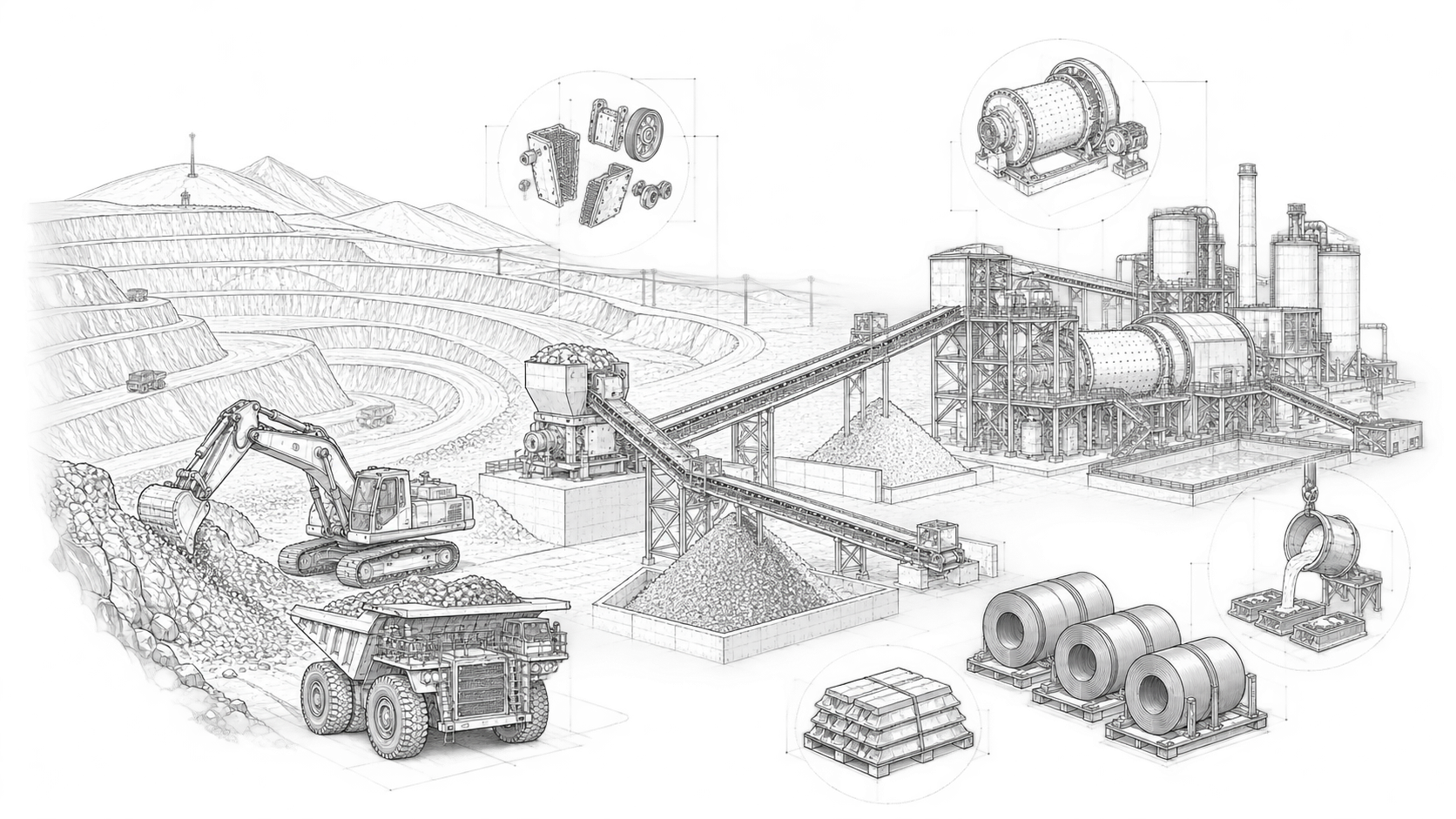
Mining and metals operations shown in monochrome technical linework

The operating reality

When you control none of the price, all of the margin is operational.

For a commodity metal, the price is set by a global market that does not know your name. You are a price-taker. And the two things beneath the price the grade in the ground and the geology you must move to reach it are getting worse everywhere: deposits are deeper, ore bodies more complex, and grades have fallen sharply across decades of extraction. The industry’s own leaders now name operational complexity, not price, as their number-one challenge, because it is the one battlefield left where the outcome is theirs to decide.

Which makes recovery the whole game. Every tonne that comes out of the face is different a different grade, a different hardness, a different mineralogy and the plant that processes it is tuned to an assumption about the ore that was true an hour, a shift or a bench ago. When the ore changes and the plant does not, metal that you already paid to mine, haul and crush leaves in the tailings. It is invisible in any single reading, because no tonne looks wrong on its own. It is enormous by the end of the quarter, because every point of recovery lost, on ore this lean, is margin you can never get back.

None of this is a failure of the geologists, metallurgists or plant operators. It is the structural default of an industry whose systems were built to optimise one truck, one mill, one flotation cell never to close the loop between the ore that actually arrives and the whole operation that must adapt to it while there is still a tonne left to save. And the adjustment that a great metallurgist learns to make leaves with them, so the next shift relearns it at the price of the recovery lost in between.

Where recovery and throughput are won or lost

The calls that decide the metal, made on ore that has already changed.

The plant tuned for ore that has already moved on

The mill and the circuit are set for the grade and hardness of the ore that was arriving. The face advances, the ore changes, and the settings that were right this morning are quietly leaving metal in the tailings this afternoon. The window to retune is open while the ore is in front of you and closed the moment it is processed. Nothing surfaced the drift as a decision in time.

The blend decided without seeing its recovery downstream

Ore is blended to feed the plant a steady diet, but the blend is set on grade alone, not on what the circuit will actually recover from it. A blend that looks balanced on paper can starve recovery in the plant, and the two decisions what to blend and how it processes live in two systems that only meet in the month’s metallurgical accounting.

The asset that degrades toward a stoppage no throughput can spare

A haul truck, a crusher, a mill drifts toward failure, and on a capital- intensive operation an unplanned stoppage is not just repair cost it is throughput lost on ore already mined, at a cost of capital more than double a technology peer’s. The window to intervene while it is planned maintenance is measured in shifts, and no system held the asset and the throughput plan as one to catch it.

An operation seen only when the metal is reconciled

Leadership sees recovery, throughput and unit cost in the monthly metallurgical accounting, in arrears, when every tuning, blending and maintenance decision that picture would have informed is already made or missed. The operation is run on a rear-view of itself precise about last month’s recovery, blind to the metal it is losing right now.

These are not four problems for four tools. They are one failure an operation that cannot adapt to its own ore in time surfacing across tuning, blending, throughput and cost at once. No single stage sees the whole operation, and no system on the site was ever built to.

The operation-wide model

One loop across the whole operation and it retunes to the ore before the metal is gone.

Existing operating estateSystems remain authoritative
Mine planBlendingProcessingMaintenance

Each system governs its own operational stage and remains a system of record.

Governed connection

Closed-loop intelligence

One live operation recovery loss surfaced and closed while there is still ore to saveQuantos connects the ore signal, accountable decision and recovered outcome as one governed record.
Existing systems stay in placeOre signal → decision → recovery outcome

Every system a mine runs today is a rear-view mirror sold as a windshield. It optimises its own stage, with precision, and goes dark at the moment the whole operation needed to adapt as one. Quantos is not that. It is an enterprise-grade, multi-tenant closed-loop intelligence system, and the loop does not break at the point a person reads the metallurgical report which is the exact point every fleet and process-control system fails.

It reads the operation as one live position mine plan, blend, processing and maintenance connected, not four stages reconciled in the month’s metal accounting. And then it does what no single-stage optimiser does: it runs the whole decision, end to end, and does not stop until the loss is closed. It ingests the ore and the operation as they run and rolls them up into one position. It forecasts the recovery loss as the ore body changes, before the metal is lost. It prices that loss in money and tonnes while the plant can still be retuned. It issues the retune, the blend change or the intervention as an accountable action to a named owner, with the evidence attached and where the call is safety-critical, it puts it in front of qualified authority, it does not take it. It tracks whether the action was executed. It captures what the plant actually recovered. It scores its own call against that outcome. It learns the ore-to-recovery pattern. And it corrects itself, so the next shift carries the lesson the last one paid for. Not a step of that is a person reading a report after the metal has already gone to the tailings.

This is not a fleet-management tool, a process-control system or a better dashboard it is not a mining product at all. It is a deterministic closed-loop intelligence system, and mining is simply the environment where, with price and grade beyond your control, closing the operational loop is the entire margin. Those tools optimise a stage and stop. Quantos decides, proves and improves across every stage as one. The industry has spent a decade getting better at accounting for the metal it lost. Quantos closes the loop that keeps the metal.
Evidence from your own operation

The metal you recovered, against the metal the loop would have held.

Read the incumbents’ own words. A fleet system optimises the trucks. A process-control layer holds a set-point. A metallurgical accounting package reports recovery after the fact. Every one of them ends at the same place: a stage optimised, or a number reported, handed to a person after the ore has already been processed. None of them checks whether the retune held, scores its own call against the recovery, or corrects the pattern that lost the metal. None of them closes the loop because none of them holds the whole operation as one live position adapting to its own ore.

Quantos holds the forecast, the retune it recommended, whether the operation acted, and what the plant then recovered. So it can show the one thing no fleet or process system can: the metal and the margin the operation actually recovered, against the metal and margin it would have held had every call been made while there was still ore to save. The distance between them is the recovery the open loop let walk to the tailings, drawn in the operation’s own metal and its own money not an estimate, not a benchmark, the margin that was really there and really recoverable.

And the shape is the cruelty of a depleting resource. The gap widens, because a recovery loss no one scored is not one bad shift it is the same misfit between ore and plant, repeating, unlearned, on ore that gets leaner every bench. Quantos holds one discipline here without exception: the gap is shown, not filled. It never invents a flattering version of the operation’s history. It shows, with evidence, the recovery that was truly there to hold because on ore this lean and capital this expensive, an answer you can audit is the only one worth acting on.

Why this cannot be answered by a better dashboard

Three things no rear-view system can do, at any price.

It draws the world that did not happen

Because Quantos alone holds the call it made, whether you acted on it and what then occurred, it can show the metal and the money you would have recovered had every call been taken against what the plant actually produced. No fleet system, no process controller, no accounting package can draw that line, because none of them carries the outcome of its own advice. It is the one view on the site a competitor cannot copy, because copying it means closing the loop, and they have not.

It keeps a scored record of every call it ever made

Every retune, every blend change, and whether it was right, held permanently a provable track record of the system’s own judgement, shift after shift. Not a dashboard that resets each morning, but an accumulating body of evidence that says, in your own metal, here is what we called and here is how it recovered. No non-loop system can produce it, because none of them ever kept the score of its own decisions.

It is the only system that gets better as the ore gets worse

Your fleet and control systems are exactly as good today as the day they were commissioned, while the ore they process gets leaner every year. Quantos moves the other way. Every shift it scores its own call, learns the ore-to-recovery pattern and corrects the next so the operation it runs this quarter recovers more from worse ore than the one it ran last quarter. It compounds. A rear-view system decays against a depleting resource. Quantos improves against it.

This is why Quantos is not a better mining tool. It is a different category of enterprise intelligence a deterministic closed loop that decides, proves and improves and a mine is simply where the margin it protects is the only margin you still control.

Proof on your own operation, not a projection

We do not ask you to trust a forecast. We replay your last quarter, shift by shift.

A forecast is a claim about a future you can argue with. Quantos offers something no argument survives: your own operation’s history, replayed. Run the loop backward across the quarter the site has already run, and watch every call it would have made appear in sequence the recovery drift flagged the shift the ore changed, not the month it showed in the accounting; the blend caught before it starved the circuit; the asset named as at-risk while the stoppage was still a planned repair. Each one timestamped ahead of the metal it saw walking to the tailings.

This is not a demonstration built on our data. It is built on yours, and it settles the only question a mine manager actually asks: not “can this system monitor,” but “would it have held the recovery on my ore, on the shift that actually lost me the metal.” The loop scores itself against the metallurgical accounting that truly landed, in the open, and lets you judge the record before you ever run an operation on it. No other system can offer that, because no other system held the whole operation as one live position long enough to have the record.

Where Quantos sits

Your systems remain. Quantos closes the loop above them.

Quantos does not ask a miner to replace anything. The fleet-management system, the process-control layer, the metallurgical accounting and maintenance platforms, the ERP and planning stack they stay, and they stay the systems of record. They were built to optimise a stage, hold a set-point and report the result, and they do it well. And the decisions that must stay with qualified people how a safety-critical asset is operated, when a process is halted remain entirely with the site’s authorised engineers. Quantos surfaces and governs; it does not take those calls.

What the existing stack was never built to do is hold the whole operation as one live position and carry the decision forward: to see the ore change, decide while there is still metal to save, measure the recovery, score the call, and keep the lesson when a metallurgist leaves. That layer has simply never existed. It exists now, it is the only thing Quantos adds, and it is deterministic, governed and evidenced end to end no black box, no fabricated output. The operation keeps everything it has built and gains the layer that turns a plant processing blind into one that adapts to its own ore in time.

For the people who own the recovery

What mining leadership asks first.

Is this a fleet-management or process-control system?

No. Those optimise one stage and report it. Quantos closes the loop across the whole operation forecasts the recovery loss as the ore changes, prices it in money and tonnes while the plant can still be retuned, drives the decision, scores it against the recovery and corrects the next. Optimising a stage is where they end. It is where Quantos begins.

Why does recovery matter so much now?

Because you control neither the price, the grade nor the geology recovery is the only margin left. With grades falling, every point of metal left in the tailings is margin you never recover, on the hardest ore you have ever processed. Quantos closes the loop between the ore that arrives and the plant that must process it.

Can it run across our mines and plants?

Yes. Quantos is enterprise-grade and multi-tenant built to run many mines, plants and blends as one loop. Each site keeps its reality; the operator finally sees the whole operation as a single forward position, not site reports reconciled after the month.

How do we act on a call we cannot see inside?

You do not have to. Quantos is deterministic every call traceable to its evidence, reproducible, governed, and safety-critical decisions left with qualified authority. No black box, no hallucination. When a point of recovery is the difference between margin and loss, an answer you can audit is the only one worth acting on.

Quantos Systems · Mining & Metals

Every loss sent a signal first.Nothing was built to act on it.Now something is.