Offerings / Industries

Quantos for FMCG

FMCG is run on the thinnest margins in the economy. And every system in the building the ERP, the planning suite, the dashboards you paid a fortune for goes blind at the one moment that decides the number: the moment a human takes over. They hand you a signal and stop. What happens next runs on instinct, and the instinct walks out the door the day your best person resigns. Quantos is the one loop that does not go blind. It keeps thinking after the decision, in your own money, with proof behind every call.

See what your systems stop watching
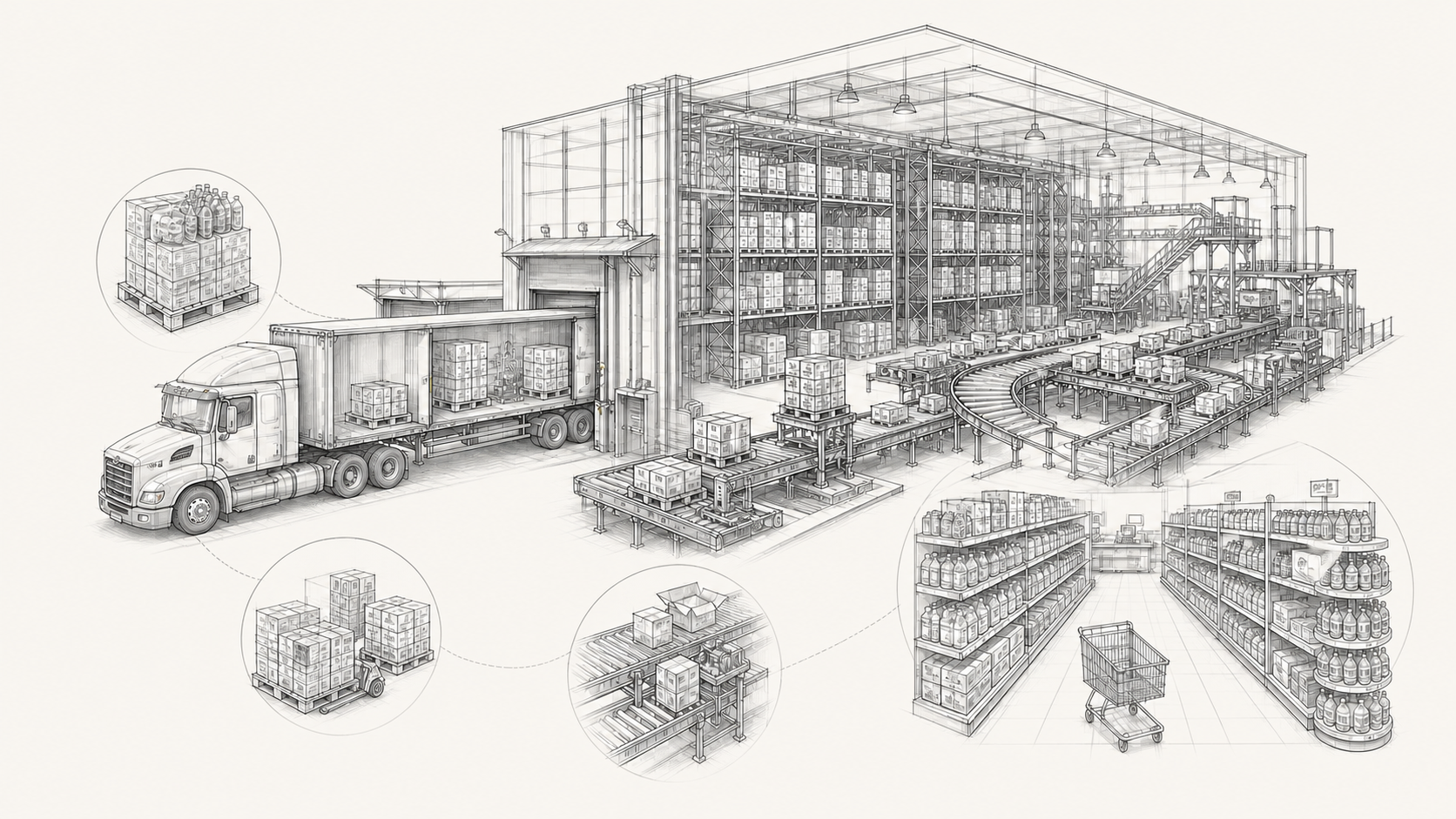
FMCG warehouse, distribution and replenishment network in monochrome technical X-ray linework

The operating reality

You are not short of data. You are short of the truth in time to use it.

No FMCG enterprise fails for lack of information. You have demand history, live inventory, offtake, trade spend, margin at every level, cash across the whole network. The systems that hold it are capable and expensive. Then, at the decisive moment, every one of them does the same thing. It produces a number, and it hands the decision to a person. That is where the intelligence ends and the guessing begins.

Everything that actually matters happens after that handover, and not one system holds any of it. Whether the call was right. What it cost. Why it was made at all. That reasoning lives in the head of whoever was in the room, and it is never written down anywhere the company can keep it. So a business running on two points of margin is run on the single most expensive input there is: a gut feeling, applied to a truth that arrived too late to change anything.

And it compounds, twice. Because no system ever scores the call against what happened, the same misjudgement returns same regions, same lines, every season, forever, because nothing in the building is capable of learning. And because the reasoning was never institutional, it leaves with the person. You do not lose an employee. You lose years of judgement in an afternoon, and you start again from zero. This is not a software gap. It is the way the entire industry has always run, and everyone has simply agreed to call it normal.
Where two points of margin are won or lost

The calls you make blind, and pay for in full.

Margin bleeds where no single desk is looking

Price, mix, trade spend and cost each move on their own, and gross margin erodes in the space between them. It surfaces at month-end, which is to say after the quarter has already eaten it. The decision that would have held the line had a window of days and no owner because nothing told anyone why to act.

Your cash is trapped in the wrong depots right now

Capital sits dead in slow lines and over-stocked locations weeks before finance sees it whole. On two points of margin, cash in the wrong place is not inefficiency it is the choice between funding the next cycle and borrowing to survive it. The signal was there. Nothing turned it into a decision.

You watched the sale walk out and confirmed it in a report

A line pulls hard in one market while its stock lies idle in another, and the report tells you once the week is already gone. The loss is not the empty shelf. It is that you could see it coming and had no machine that turned seeing into deciding while it still mattered.

Risk piles up under a name nobody has assigned

Exposure gathers quietly in a region, a channel, a handful of lines carrying weight far beyond their size. Every desk sees its slice; no one sees the whole. It becomes visible the moment it becomes a loss never one second earlier because the connected view that would have caught it was never built.

These are not four problems waiting for four tools. They are one failure intelligence that dies at the handover surfacing in four places at once. No desk can see across them, and no system you own was ever built to.

The network operating model

The first system that keeps thinking after the human decides.

Every system you run today is a rearview mirror sold to you as a windshield. It shows you where you have been with great precision and goes dark the instant you need to know where to steer. Quantos is not that. It is a closed-loop intelligence system, and the loop does not break at the point a person takes over which is the exact point every other system fails.

It reads the enterprise as one position demand, margin, cash and exposure connected, not four dashboards on four screens. It surfaces the forward risk in rupees and days while the outcome can still be changed. And it does the thing no system before it has done: it tells you why the decision has to be made now, hands that reasoning to an accountable owner with the evidence attached, and then stays in the room. It checks what happened. It scores its own call against reality. It keeps that record permanently, so the reasoning becomes the institution’s and not one person’s and so the same mistake is not paid for twice.

This is not a better forecast, a richer dashboard or a smarter plan. Those describe the world and stop. Quantos decides, proves and improves. It is a different category of system, and FMCG where the margin is thinnest and the truth is most expensive when it is late is exactly where the difference is felt first.

Evidence from your own network

The money you left on the table, drawn in your own currency.

Quantos alone holds the forecast, the decision it recommended, whether you followed it, and what then occurred. So it can put on one screen the thing no record system can: the cash you actually captured, against the cash you would have captured had every call been followed. The distance between those two lines is the price of deciding late not an estimate, not a sales figure, your own money, already gone.

And read the shape, not just the size. The wedge widens. A missed call is not a one-time loss you absorb and move past it is a leak that opens further every cycle the loop stays open, because the mistake no one scored is the mistake you make again. What looks like a small gap in month one is a structural bleed by month twelve. That is the true cost of running blind: not the single decision, but the compounding.

An ERP cannot draw that line. A dashboard cannot. A planning tool cannot. A generative model certainly cannot. None of them carry the world that did not happen, because none of them ever closed the loop to record it. And Quantos holds one discipline here without exception: the gap is shown, not filled. It will never invent a prettier version of your history to flatter you. It shows you, with evidence, the one that was real because an answer you cannot audit is worthless on a thin margin, and an answer you can is the only one worth acting on.

Proof on your own network, not a projection

We do not ask you to trust a forecast. We replay your last year.

A forecast is a claim about a future you can argue with. Quantos offers something no argument survives: your own history, replayed. Run the loop backward across the year you have already lived, and watch every call it would have made appear in sequence the stockout flagged weeks before the shelf ran dry, the margin erosion named before the quarter absorbed it, the capital caught before it was stranded. Each one timestamped ahead of the loss it saw coming.

This is not a demonstration built on our data. It is built on yours, and it settles the only question that matters to a decision-maker: not “can this system predict,” but “would it have been right on my business, in my year, on the calls I actually got wrong.” The loop scores itself against what truly happened, in the open, and lets you judge the record before you ever depend on it. No other system can offer that, because no other system kept the loop closed long enough to have the record.

Where Quantos sits

Your systems remain. Quantos adds that missing Intelligence layer & closes the loop above them.

Quantos does not ask you to rip anything out. The ERP, the demand and distribution systems, the finance stack they stay, and they stay the systems of record. They were built to capture, process and report, and they do it well. They were never built to carry the decision forward: to hold the reasoning, measure the outcome, score the call, and keep the intelligence when a person leaves. That layer has simply never existed.

It exists now, and it is the only thing Quantos adds. It sits above the stack you already own, works from the data you already approve, and closes the loop those systems leave open at the handover. Deterministic, governed, evidenced no black box, no fabricated output, the reasoning traceable end to end. You keep everything you have built. You gain the layer that makes it think as one enterprise instead of a dozen blind desks.

For the people who own the number

What decision-makers ask first.

Is this a forecasting or supply-chain system?

No. A forecast tells you what will happen and goes quiet. Quantos reads demand, margin, cash and exposure as one position, tells you why to act now, drives the decision to an owner, and keeps the record of whether it was right. Forecasting is one signal in the loop, not the loop.

We already have data and dashboards. What is missing?

Reasoning, and memory. Your systems hand the decision to a person and the why, the outcome and the learning leave with them. Quantos closes that gap proof behind every call, and a permanent scored record the institution keeps.

How do we trust a call we cannot see inside?

You do not have to. Quantos is deterministic every call traceable to its evidence, reproducible, governed. No black box, no hallucination. On a thin margin, an answer you can audit is the only answer worth acting on.

Do we have to replace what we run today?

No. Your systems remain the systems of record. Quantos sits above them and closes the loop they leave open. Nothing is discarded.

Quantos Systems · FMCG

Every loss sent a signal first.Nothing was built to act on it.Now something is.