Offerings / Industries

Quantos for Energy & Utilities

Electricity is the only product in the economy that must be manufactured at the exact instant it is consumed. It cannot be stored at scale, so supply and demand have to match every second of every day or the grid itself destabilises. And a utility has to win that match against two things moving at once demand that has turned sharp and volatile, and a supply that now swings with the weather as renewables come on and off. The decision that commits most of the cost, power procurement, is made ahead on a forecast; the reality it has to meet plays out live on the grid. Every gap between them is paid for in costly short-term purchase, in curtailed clean energy, in the loss that sits under a book already carrying lakhs of crore. Quantos is the one loop that closes the distance between the forecast, the commitment and the real-time balance before the gap becomes the loss.

See the loss that lives in the gap
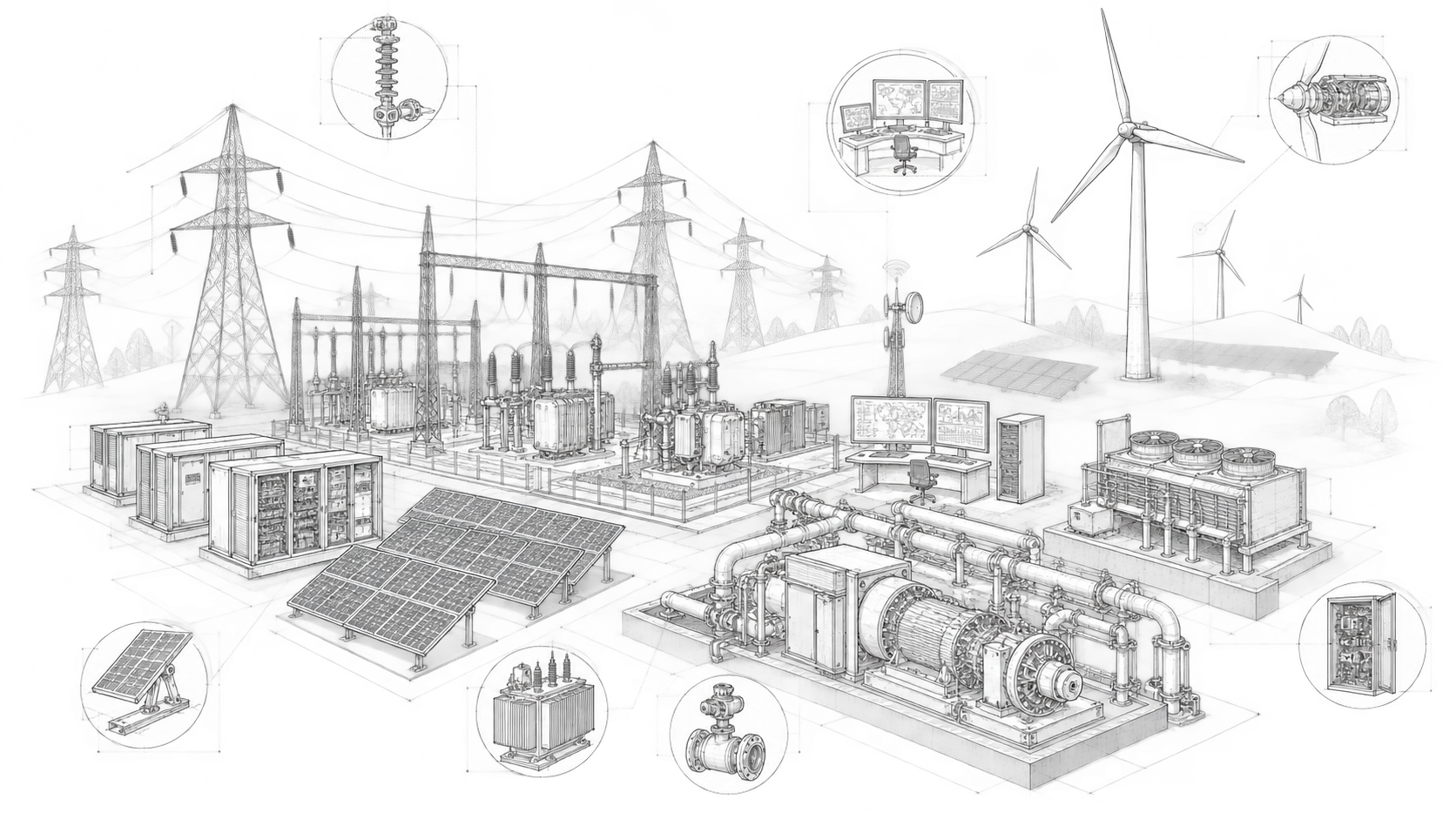
Energy and utility infrastructure shown in monochrome technical linework

The operating reality

A product that cannot be stored, matched against two things that will not hold still.

Every other business can hold inventory to absorb a mistake. A utility cannot. The product is made and consumed in the same instant, and the balance between what is generated and what is drawn has to hold continuously or the frequency drifts, the voltage rises, the feeder congests. That single physical fact turns every planning error into an immediate operational and financial event there is no warehouse to park the gap in.

And the two sides of the balance have both become harder at once. Demand has stopped being a smooth curve; it spikes and swings with new loads and shifting patterns. Supply has stopped being firm; as solar and wind grow, generation moves with the weather, and the same clean capacity that was built to cut cost injects voltage rise and reverse flow into a network never designed for it. The utility is now balancing two moving targets in real time, on infrastructure built for one that stood still.

Underneath the physics sits the money, and it is decided before the physics happens. Power procurement is the majority of the cost of supply and is largely outside the utility’s direct control, and it is committed ahead on a forecast of a demand that has become volatile and a supply that has become intermittent. When the forecast is wrong, the utility buys the shortfall expensively on the short-term market, or spills renewable energy it has already paid for, or absorbs the mismatch as loss. None of it is a failure of the operators or the planners. It is the structural default of an industry whose systems balance the grid in one place and commit the money in another, and reconcile the two only at settlement after the second has passed and the gap is already a number.

Where cost of supply and loss are won or lost

The calls that decide the gap, made in separate rooms.

The power bought ahead against a forecast that moved

Procurement is committed on a demand forecast days out, and demand arrives sharper or softer than the curve assumed. Short by a gigawatt, the utility buys expensively on the short-term market; long, it backs down cheap generation or spills renewable energy it already paid for. The commitment was locked before the reality formed, and the gap between them is the largest cost line in the business.

The clean energy curtailed because the network could not take it

Solar and wind surge into a feeder that was not built for two-way flow, and the choice is to curtail generation the utility is contracted to pay for or to risk the voltage and congestion. The signal that a pocket of the network was heading for reverse flow formed before the curtailment; nothing connected it to the procurement and dispatch decision while there was still a way to place the energy.

The loss that hides between what was supplied and what was paid for

Aggregate technical and commercial loss is the ratio of power the utility never got paid for to power it procured, and it forms across metering, billing, collection and distribution each visible in its own system, none of them assembled into one forward exposure. It surfaces in the annual rating, in arrears, long after the decisions that would have moved it were made.

A utility seen only when the books are settled

Leadership sees the cost of supply, the revenue gap and the loss at settlement and in the rating exercise, in arrears, when every procurement, dispatch and network decision that picture would have informed is already made. The utility is run on a rear-view of itself precise about last period’s loss, blind to the imbalance forming on the grid right now.

These are not four problems for four tools. They are one failure a match that must hold every second, decided in systems that meet only at settlement surfacing across procurement, curtailment, loss and revenue at once. No single system sees the balance from forecast to settlement, and none of them was ever built to.

What Quantos is

One loop from the forecast to the settlement closing the gap the grid opens every second.

Every system a utility runs today holds one part of the balance. SCADA and the energy- management system operate the grid in real time. Metering and the MDM record what was consumed. Forecasting tools project the demand. The ERP settles the money. Each is excellent in its slice, and each hands its number to a person after the second it describes has already passed. They run the grid and read the meter; not one of them closes the loop between the forecast that commits the money and the real-time balance that spends it.

Quantos is that loop. It sits above the stack you already run and reads the utility as one live position demand, procurement, generation, network state, loss and revenue connected, not a control room and a settlement sheet that meet after the period. It carries the forward exposure of a procurement or dispatch decision to the moment it lands: this demand shape leaves you short here and long there, this pocket of the network is heading for reverse flow, this loss is forming in this division here is the correction, here is the money and the units it protects, here is why it has to be made now, before settlement. It hands that call, with the evidence, to the accountable owner and where the decision is real-time grid dispatch or protection, it stays with the load-dispatch authority under CERC and the SLDC; Quantos does not operate the grid. It watches what the balance then did. It scores its own call against the settlement. It learns how a demand shape turns into a cost and a loss. And it corrects the next cycle, so the procurement you commit ahead is sharpened by every gap the last cycle scored.

This is not a SCADA upgrade, a smarter forecast or another loss-reduction dashboard it is not a utility point-solution at all. It is a deterministic closed-loop intelligence system, and energy is simply the environment where the product cannot be stored, the balance is unforgiving, and the money is committed before the physics is known. Those systems run the grid and settle the books, and stop. Quantos decides, proves and improves across generation, grid and distribution as one. The industry has spent a decade getting better at metering the loss. Quantos closes the loop that produces it.
The proof no competitor can draw

The cost of supply you carried, against the cost the loop would have held.

Read the incumbents’ own words. An EMS balances the grid. A forecasting tool projects the load. An MDM records the meter. An ERP settles the account. Every one of them ends at the same place: a real-time state, a projection, or a settled number, handed to a person on one side of the gap between committing the money and meeting the demand. None of them checks whether the procurement call landed the balance it should have, scores itself against the settlement, or corrects the next commitment. None of them closes the loop because none of them holds the balance from forecast to settlement as one.

Quantos holds the forecast, the procurement and dispatch call it recommended, whether the utility acted, and what the balance then settled at. So it can show the one thing no EMS or settlement system can: the cost of supply and the loss the utility actually carried, against the cost and loss it would have carried had every call been made while the gap could still be closed. The distance between them is the money the open loop let through the short-term premiums paid, the clean energy curtailed, the loss unbilled drawn in the utility’s own money and its own units, not an estimate, not a benchmark, the exposure that was really there and really recoverable.

And the shape is the whole exposure of a product that cannot be stored. The gap widens, because a forecast miss left unscored is not one expensive hour it is the same blind spot, repeating across every settlement period, as demand grows more volatile and renewables grow more intermittent. Quantos holds one discipline here without exception: the gap is shown, not filled. It never invents a flattering version of the utility’s history. It shows, with evidence, the cost of supply that was truly there to hold because for a decision that moves the largest cost line in the business and answers to a regulator, an answer you can audit is the only one worth acting on.

Why this cannot be answered by a better control room

Three things no rear-view system can do, at any price.

It draws the world that did not happen

Because Quantos alone holds the call it made, whether you acted on it and what the balance then settled at, it can show the cost of supply you would have carried had every gap been closed in time against what the utility actually paid. No EMS, no forecasting tool, no settlement system can draw that line, because none of them carries the outcome of its own advice. It is the one view in the utility a competitor cannot copy, because copying it means closing the loop, and they have not.

It keeps a scored record of every call it ever made

Every procurement and network call, and whether it held the balance, kept permanently a provable track record of the system’s own judgement, period after period. Not a settlement sheet that closes each cycle, but an accumulating body of evidence that says, in your own cost of supply, here is what we called and here is how it settled. No control or settlement system can produce it, because none of them ever kept the score of its own decisions.

It is the only system that gets better as the grid gets harder

Your EMS and forecasting tools are exactly as good today as the day they were configured, while the grid they balance grows more volatile every year with every gigawatt of renewables. Quantos moves the other way. Every cycle it scores its own call, learns how a demand shape turns into cost and corrects the next so the balance it holds this period costs less than the one it held last period, on a harder grid. It compounds. A rear-view system decays against a volatile grid. Quantos improves against it.

This is why Quantos is not a better utility tool. It is a different category of enterprise intelligence a deterministic closed loop that decides, proves and improves and a grid is simply where the product it protects cannot be stored and the balance cannot wait.

Proof on your own grid, not a projection

We do not ask you to trust a forecast. We replay your last year, period by period.

A forecast is a claim about a future you can argue with. Quantos offers something no argument survives: your own utility’s history, replayed. Run the loop backward across the year the utility has already balanced, and watch every call it would have made appear in sequence the demand shape flagged before the procurement was committed against it; the network pocket named before it forced a curtailment; the loss caught before it settled into the rating. Each one timestamped ahead of the cost it saw forming.

This is not a demonstration built on our data. It is built on yours, and it settles the only question a utility leader actually asks: not “can this system forecast,” but “would it have held the cost of supply on my grid, on the period that actually blew the power-purchase budget.” The loop scores itself against the settlement that truly landed, in the open, and lets you judge the record before you ever run the grid on it. No other system can offer that, because no other system held the balance from forecast to settlement as one long enough to have the record.

Where Quantos sits

Your systems remain. Quantos closes the loop above them.

Quantos does not ask a utility to replace anything. The SCADA and energy-management systems, the metering and MDM, the forecasting and trading tools, the ERP and settlement stack they stay, and they stay the systems of record. They were built to run the grid, read the meter, project the load and settle the account, and they do it well. And the decisions that must stay with the operator and its regulator real-time dispatch, protection, grid security remain entirely with the load- dispatch authority under CERC and the relevant SLDC. Quantos does not operate the grid.

What the existing stack was never built to do is hold the balance from forecast to settlement as one and carry the decision forward: to connect the demand forecast to the procurement commitment to the real-time reality, decide while the gap can still be closed, measure the settlement, score the call, and keep the lesson when a planner leaves. That layer has simply never existed. It exists now, it is the only thing Quantos adds, and it is deterministic, governed and evidenced end to end no black box, no fabricated output. The utility keeps everything it has built and gains the layer that closes the gap before the second passes and the gap becomes the loss.

For the people who own the cost of supply

What utility leadership asks first.

Is this a SCADA, EMS or metering system?

No. Those run the grid, read the meter and forecast the load, each in its slice, and hand the result to a person. Quantos closes the loop across them connects the forecast to the procurement commitment to the real-time balance to the settlement, surfaces the forward gap in money and units while it can still be closed, drives the decision, scores it and corrects the next cycle. Running the grid is where they end. It is where Quantos begins.

Why do we lose money even when demand is met?

Because power cannot be stored, so supply and demand must match every second, and procurement most of the cost, largely outside your control is committed ahead on a forecast while the balance plays out live. Wrong forecast, and the gap is filled by costly purchase, curtailed clean energy or absorbed loss. Quantos closes the loop between the forecast, the commitment and the real-time reality.

Can it run across generation, transmission and distribution?

Yes. Quantos is enterprise-grade and multi-tenant built to run generation, procurement, the grid and distribution as one forward position, not systems reconciled at settlement. Each function keeps its reality; the utility finally sees demand, procurement, balance, loss and revenue on one loop.

How do we act on a call we cannot see inside?

You do not have to. Quantos is deterministic every call traceable to its evidence, reproducible, governed, and real-time dispatch left with the load-dispatch authority under CERC and the SLDC. No black box, no hallucination. For a decision that moves the largest cost line in the business and answers to a regulator, an answer you can audit is the only one worth acting on.

Quantos Systems · Energy & Utilities

Every loss sent a signal first.Nothing was built to act on it.Now something is.