Offerings / Industries

Quantos for Agriculture & Agri-business

The moment produce is harvested, two clocks start running against it and neither can be stopped. The first is biological: quality falls by the hour, moisture and heat turn saleable produce into loss and sometimes contamination, and a large share of the crop is gone before it ever reaches a buyer. The second is commercial: the price crashes in the harvest glut when everyone sells at once, and spikes in the lean season when the produce is gone so the same commodity is worth least exactly when there is most of it. An agri-business must decide when to procure, whether to store, when to process and where to dispatch, all against a value decaying two ways at once, and it must coordinate those decisions across a chain that is fragmented, uneven and full of intermediaries. Quantos is the one loop that closes the distance between both clocks and the decision before the value decays past recovering.

See the value both clocks take
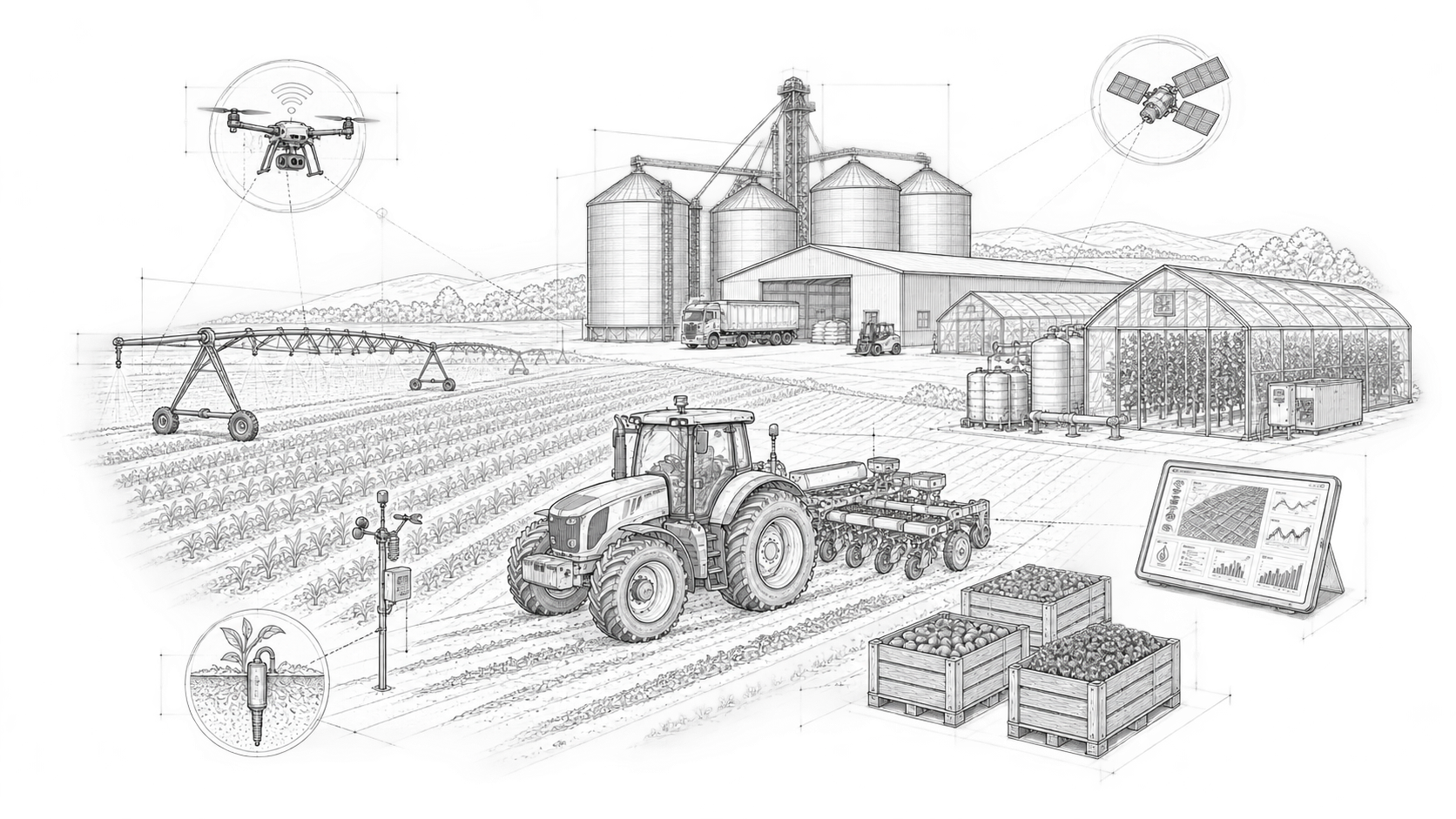
Agriculture and agribusiness operations shown in monochrome technical linework

The operating reality

Two clocks, one perishable asset, a chain that cannot move fast enough.

Agri-business is the only sector where the core asset is actively destroying itself while you decide what to do with it. From the instant of harvest, produce is on a biological countdown respiration, moisture, temperature and pests steadily convert quality into loss, and for many commodities a small rise in moisture is not just spoilage but contamination that renders the stock unfit for trade entirely. A large fraction of India’s produce is lost this way before it reaches a market, and the loss is worst precisely where the value is highest, in perishables.

While that clock runs, a second one runs against it. Because so much of a crop arrives at once and so little can be held, the price collapses in the harvest glut and climbs in the lean months the commodity is worth the least at the exact moment there is the most of it, and the most when it is already gone. So the agri-business is caught: sell now into a crashed price to avoid the decay, or hold for a better price and risk the produce decaying before it gets there. Every procurement, storage, processing and dispatch decision is a bet placed against both clocks at once.

And the chain that has to beat them is fragmented. Cold storage is uneven and concentrated in a few commodities and states, rail rakes are scarce, rural roads are slow, and the produce passes through many hands between farm and buyer. None of this is a failure of the procurement teams, the storage managers or the traders. It is the structural default of an industry whose systems buy in one place, store in another, process in a third and price in a fourth and reconcile the whole into realisation and loss only after the season, when the decay is done and the price has moved. The signals of both clocks exist while there is still a decision to change; no system closes the loop between them and the action in time.

Where realisation and loss are won or lost

The calls that decide the crop, made against two clocks and a slow chain.

The produce held for a price it decayed before reaching

Stock is held back for a better lean-season price, and the biological clock wins quality falls, a grade is lost, moisture tips a batch into contamination, and the produce is worth less or nothing by the time the price arrives. The signal that decay was outrunning the price gain was there before the loss; nothing connected the two clocks into a single decision while the stock could still move.

The crop dumped into a glut it did not have to sell into

Facing decay and no storage, produce is sold immediately into the harvest glut at a crashed price, when storage, processing or a different market would have held far more of its value. The distress sale looked like the only option because the alternatives capacity, a processing slot, a lean-season buyer lived in systems that never assembled into one view in time to act.

The capacity and processing slot that sat idle or overflowed

Storage and processing capacity is finite and must be matched to a harvest that arrives in a rush, and the match is made too late capacity overflows and rejects supply, or sits idle while produce spoils in the field. The signal of what was coming and what could hold it formed before the harvest peaked; nothing connected the inbound crop to the capacity while there was still time to balance them.

A chain seen only when realisation and loss are counted

Leadership sees realisation, post-harvest loss and capacity utilisation after the season, in arrears, when every procurement, storage, processing and dispatch decision that picture would have informed is already made. The chain is run on a rear-view of itself precise about last season’s loss, blind to the decay and the price moving against the crop it is holding right now.

These are not four problems for four tools. They are one failure a perishable asset decaying on two clocks, decided across a fragmented chain surfacing across procurement, storage, processing and price at once. No single system sees the crop from harvest to sale as one, and none of them was ever built to.

What Quantos is

One loop from harvest to sale closing the gap both clocks open.

Every system an agri-business runs today holds one link of the chain. The procurement system buys. The warehouse and cold-chain systems store and monitor. The processing system converts. The trading system and the ERP price and settle. Each is excellent at its link, and each hands its number to a person after the produce it describes is already decaying or already sold. They buy and store; not one of them closes the loop between the two clocks running against the crop and the decision that could still beat them.

Quantos is that loop. It sits above the stack you already run and reads the chain as one live position inbound harvest, decay state, storage and processing capacity, freight, and the price curve connected, not a procurement system and a trading desk that meet after the season. It carries the forward consequence of both clocks to the moment it would land: this stock is decaying faster than the lean- season price will reward, move it now; this crop is heading into a glut that storage or processing could lift it out of; this capacity is about to overflow while produce spoils in the field here is the decision, here is the realisation it protects, here is why it has to be made now, before the value is gone. It hands that call, with the evidence, to the accountable owner and where the decision is food safety or quality, it stays with qualified authority. It watches what the crop then realised. It scores its own call against the realisation and the loss. It learns how decay, price and capacity turn into value. And it corrects the next cycle, so the crop you commit is set against the two clocks it will actually face.

This is not a better procurement system, a smarter cold-chain monitor or another trading tool it is not an agri point-solution at all. It is a deterministic closed-loop intelligence system, and agriculture is simply the environment where the asset decays biologically and commercially at the same time and the chain to beat it is most fragmented. Those systems buy and store, and stop. Quantos decides, proves and improves across sourcing, storage, processing and sale as one. The industry has spent a decade getting better at storing the crop. Quantos closes the loop that saves its value.

The proof no competitor can draw

The realisation you kept, against what the loop would have held.

Read the incumbents’ own words. A procurement system buys the crop. A cold-chain system monitors the store. A processing system converts. A trading system prices. Every one of them ends at the same place: a purchase, a temperature log, a yield, or a price, handed to a person after the produce is already decaying or sold. None of them checks whether the call beat the two clocks, scores itself against the realisation and the loss, or corrects the next cycle. None of them closes the loop because none of them holds the crop from harvest to sale as one.

Quantos holds the call it made on procurement, storage, processing and dispatch, whether the agri-business acted, and what the crop then realised. So it can show the one thing no procurement or trading system can: the realisation the chain actually kept, against the realisation it would have kept had every call been made while the produce could still move. The distance between them is the value the open loop let decay the stock lost to spoilage, the crop dumped into a glut, the capacity idle while produce rotted drawn in the agri-business’s own money and its own tonnes, not an estimate, not a benchmark, the value that was really there and really recoverable.

And the shape is the whole cost of a perishable asset on two clocks. The gap widens, because a crop held too long or dumped too early is not one bad batch it is the same blind spot, repeating across every commodity and every season, on produce that decays by the hour and a price that swings by the month. Quantos holds one discipline here without exception: the gap is shown, not filled. It never invents a flattering version of the chain’s history. It shows, with evidence, the realisation that was truly there to hold because when produce decays by the hour and the price moves by the day, a decision you can audit is the only one worth acting on.

Why this cannot be answered by a better cold chain

Three things no rear-view system can do, at any price.

It draws the world that did not happen

Because Quantos alone holds the call it made, whether you acted on it and what the crop then realised, it can show the realisation you would have kept had every call beaten the two clocks against what the chain actually kept. No procurement system, no cold-chain monitor, no trading tool can draw that line, because none of them carries the outcome of its own advice. It is the one view in the chain a competitor cannot copy, because copying it means closing the loop, and they have not.

It keeps a scored record of every call it ever made

Every procure, store, process and dispatch call, and whether it held the realisation, kept permanently a provable track record of the system’s own judgement, season after season. Not a post-season report filed and forgotten, but an accumulating body of evidence that says, in your own realisation, here is what we called and here is how the crop landed. No procurement or trading system can produce it, because none of them ever kept the score of its own decisions.

It is the only system that gets better every season

Your procurement and cold-chain systems are exactly as good today as the day they were configured. Quantos is not. Every season it scores its own call, learns how decay, price and capacity turn into realisation and sharpens the next so the crop it protects this season keeps more of its value than the one it protected last season, against the same two clocks. It compounds. A rear-view system meets each harvest from scratch. Quantos carries every season’s lesson into the next.

This is why Quantos is not a better agri tool. It is a different category of enterprise intelligence a deterministic closed loop that decides, proves and improves and a supply chain is simply where the loop it closes beats two clocks at once.

Proof on your own chain, not a projection

We do not ask you to trust a forecast. We replay your last season, crop by crop.

A forecast is a claim about a future you can argue with. Quantos offers something no argument survives: your own chain’s history, replayed. Run the loop backward across the season the business has already traded, and watch every call it would have made appear in sequence the stock flagged as decaying faster than the price would reward before it was held; the crop named as dumpable into storage before it hit the glut; the capacity caught before it overflowed. Each one timestamped ahead of the loss it saw forming.

This is not a demonstration built on our data. It is built on yours, and it settles the only question an agri-business leader actually asks: not “can this system store,” but “would it have held the realisation on my chain, on the crop that actually decayed or sold into the glut.” The loop scores itself against the realisation that truly landed, in the open, and lets you judge the record before you ever run the chain on it. No other system can offer that, because no other system held the crop from harvest to sale as one long enough to have the record.

Where Quantos sits

Your systems remain. Quantos closes the loop above them.

Quantos does not ask an agri-business to replace anything. The procurement systems, the warehouse and cold-chain systems, the processing and quality systems, the trading and ERP stack they stay, and they stay the systems of record. They were built to buy, store, convert and price, and they do it well. And the decisions that must stay with qualified people food safety, quality determination remain entirely with the authorised authority. Quantos surfaces and governs; it does not make those calls.

What the existing stack was never built to do is hold the crop from harvest to sale as one and carry the decision forward: to connect the decay, the price and the capacity signals to the procure, store, process and dispatch decision, decide while the produce can still move, measure the realisation, score the call, and keep the lesson when a procurement head leaves. That layer has simply never existed. It exists now, it is the only thing Quantos adds, and it is deterministic, governed and evidenced end to end no black box, no fabricated output. The agri-business keeps everything it has built and gains the layer that beats the two clocks before the value is gone.

For the people who own realisation and loss

What agri-business leadership asks first.

Is this a procurement, warehouse or cold-chain system?

No. Those buy, store and monitor, each on its own link. Quantos closes the loop across them connects the decay, price and capacity signals to the procure, store, process and dispatch decision to the realised outcome, surfaces the forward exposure in money and days while the produce can still move, drives the decision, scores it and corrects the next cycle. Buying and storing are where they end. It is where Quantos begins.

Why do we lose so much value after harvest?

Because produce decays on two clocks at once biologically from harvest, and commercially as the price crashes at glut and spikes in lean season while the chain to move it is fragmented. The procure, store and dispatch decision is committed against a value decaying both ways. Quantos closes the loop between both clocks and the decision.

Can it run across sourcing, storage and processing?

Yes. Quantos is enterprise-grade and multi-tenant built to run sourcing, storage, processing and dispatch across every region as one forward position, not systems reconciled after the season. Each node keeps its reality; the agri-business finally sees decay, price, capacity and realisation on one loop.

How do we act on a call we cannot see inside?

You do not have to. Quantos is deterministic every call traceable to its evidence, reproducible, governed, and food-safety and quality left with qualified authority. No black box, no hallucination. When produce decays by the hour and the price moves by the day, a decision you can audit is the only one worth acting on.

Quantos Systems · Agriculture & Agri-business

Every loss sent a signal first.Nothing was built to act on it.Now something is.