Offerings / Industries

Quantos for Oil & Gas

Spend is rising and output is falling. Capital is being committed at the largest scale in a generation, and domestic production keeps declining not through negligence, but through the physics of the business: capital is deployed years before the first barrel it buys, the reservoir depletes the whole time you wait, and by the time you learn whether a programme worked, the field has declined further and the next programme is already sanctioned on the same assumptions the last one just disproved. In a country importing the vast majority of its crude, every barrel of lost domestic output is bought abroad in a weakening rupee. Quantos is the one loop that closes the distance between the capital call and its consequence while the next programme can still be corrected, across the whole portfolio as one.

See the barrel you sanctioned before you could see it
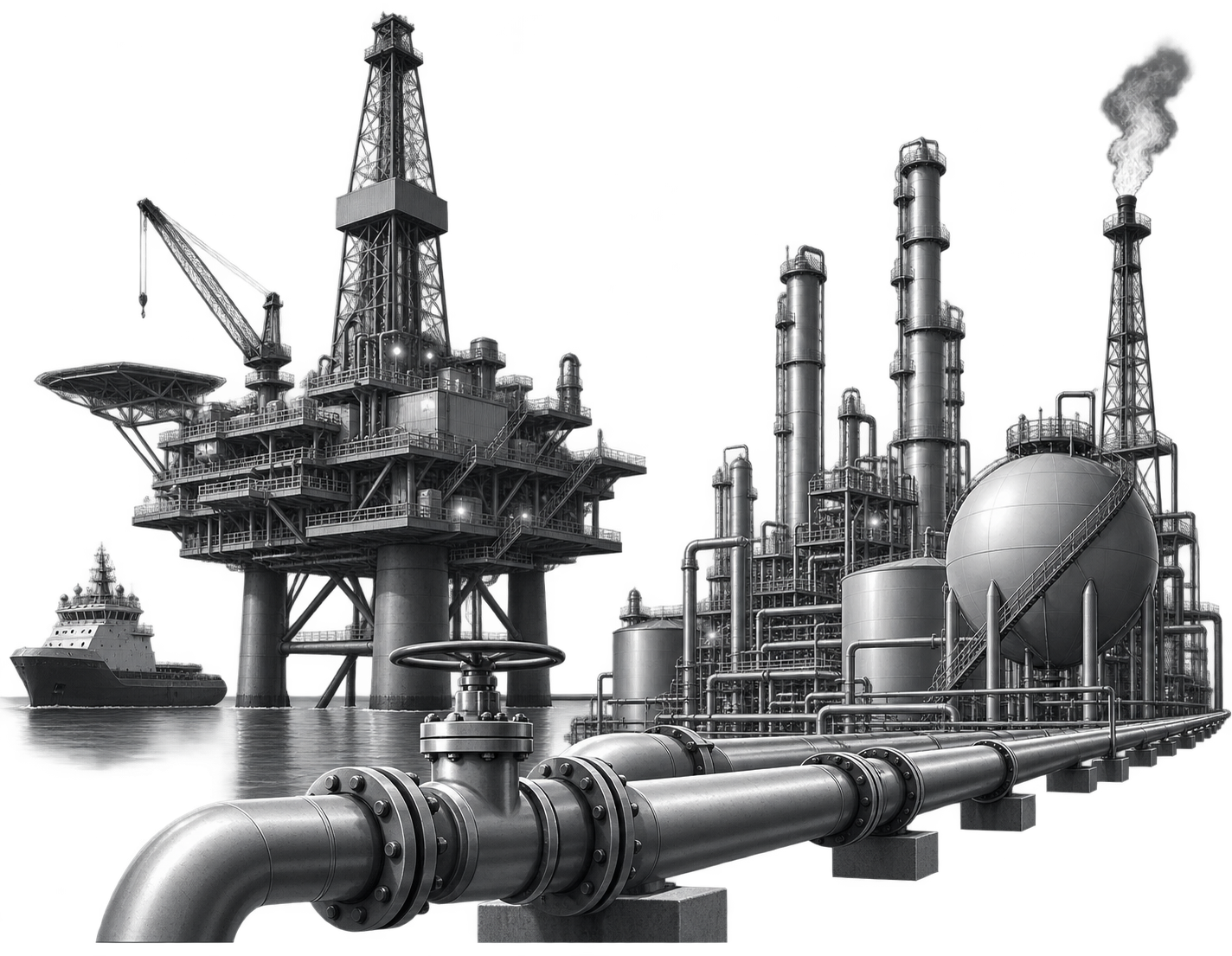
Oil and gas operations shown in monochrome technical linework

The operating reality

The capital is committed years before the outcome is known.

Oil and gas runs on the longest lag in industry. A well, an enhanced-recovery flood, a field redevelopment is sanctioned today on a model of a reservoir no one can see directly. The capital is enormous sovereign-scale, at a cost of capital that punishes every year of delay. And the answer to whether the call was right arrives years later, in the production it does or does not deliver. In between, the reservoir depletes at rates that compound, ageing fields fall faster, and a well drilled but not connected to evacuation infrastructure produces nothing while the capital clock runs.

The result is the pattern that has drawn parliamentary scrutiny: capital expenditure climbing sharply while domestic output declines. It is not that the money is wasted. It is that each programme is committed before the last one could be judged so a wrong assumption about recovery, about decline, about timing is not corrected once; it is written into the next sanction, and the one after, before the production data ever comes back to disprove it. The decision and its consequence are separated by years, and nothing closes the loop between them while the capital can still be redirected.

None of this is a failure of the reservoir engineers, the drillers or the planners. It is the structural default of an industry whose systems were built to model an asset and report production after it flows, never to close the loop between a capital call and its outcome while the programme could still change. And the judgement a great reservoir engineer builds over a field’s life leaves with them, so the next redevelopment relearns it at the price of the barrels lost in between.

Where output and capital efficiency are won or lost

The calls that decide the barrel, made blind to their own outcome.

The programme sanctioned on an assumption the last one disproved

A redevelopment or recovery programme is committed on a model of decline and recovery. Because the production feedback arrives years later, the same model is written into the next sanction in the meantime. One wrong assumption is not one loss it is a loss multiplied across every programme committed before the barrels came back to correct it.

The well that produces nothing because the evacuation is not ready

Capital drills a well, and the well waits for the pipeline, the grid connection, the processing capacity that was planned on a separate timeline. Activity becomes output only when the whole chain is sequenced together, and when it is not, sovereign capital sits in the ground producing nothing while the clock runs. The two decisions lived in two plans and met too late.

The declining field managed on last quarter’s picture

An ageing field declines faster than the plan assumed, and the intervention that would arrest it a workover, a flood adjustment, an artificial-lift change has a window that closes while the picture is still being reconciled. The decline was visible in the data forming; no system surfaced it as a decision while there was still a barrel to hold.

A portfolio seen only when the results are booked

Leadership sees production, capital efficiency and decline across the portfolio in the quarterly result, in arrears, when every sanction and intervention that picture would have informed is already made. The portfolio is run on a rear-view of itself precise about last quarter’s output, blind to the capital it is committing today on assumptions it cannot yet test.

These are not four problems for four tools. They are one failure a capital decision separated from its outcome by years surfacing across sanction, execution, decline and efficiency at once. No single asset sees the portfolio as one live position, and no system in the operation was ever built to.

The portfolio operating model

One loop across the whole portfolio and it scores the call before the next is committed.

Every system an operator runs today is a rear-view mirror sold as a windshield. It models the asset and reports the production, with precision, and goes dark at the moment the capital call needed to meet its own outcome. Quantos is not that. It is an enterprise-grade, multi-tenant closed-loop intelligence system, and the loop does not break at the point a person reads the quarterly result which is the exact point every production and reservoir system fails.

It reads the portfolio as one live position reservoir, wells, execution, evacuation, capital and output connected, not four views reconciled at the quarter. And then it does what no modelling or reporting tool does: it runs the whole decision, end to end, and does not stop until the loop is closed. It ingests the assets as they produce and rolls them up into one position. It forecasts the outcome of a capital or operating call against a depleting asset, before the years of lag can hide it. It prices that outcome in money and barrels while the programme can still be changed. It issues the sanction adjustment, the sequencing change or the intervention as an accountable action to a named owner, with the evidence attached and where the call is safety-critical or regulated, it puts it in front of qualified authority, it does not take it. It tracks whether the action was executed. It captures what the asset actually produced. It scores its own call against that outcome. It learns the decline-to-outcome pattern. And it corrects itself, so the next sanction carries the lesson the last one paid for before it is committed, not years after. Not a step of that is a person reading a result after the capital is already sunk.

This is not a production platform, a reservoir simulator or a better dashboard it is not an oil-and-gas product at all. It is a deterministic closed-loop intelligence system, and oil and gas is simply the environment where the lag between a decision and its consequence is longest and the capital at stake is largest. Those tools model the asset and stop. Quantos decides, proves and improves across every asset as one. The industry has spent decades getting better at reporting the production. Quantos closes the loop that produces it.
Evidence from your own portfolio

The output you booked, against the output the loop would have held.

Read the incumbents’ own words. A reservoir simulator models the field. A production system reports the flow. A capital-planning tool schedules the spend. Every one of them ends at the same place: a model, or a number, handed to a person after the capital is committed and the barrels are counted. None of them checks whether the sanction was right, scores its own call against the production, or corrects the assumption before the next programme is committed on it. None of them closes the loop because none of them holds the capital decision and its outcome as one.

Quantos holds the forecast, the call it recommended, whether the operator acted, and what the asset then produced. So it can show the one thing no production or reservoir system can: the output and the capital efficiency the portfolio actually delivered, against the output and efficiency it would have held had every call been made and scored while the programme could still change. The distance between them is the barrels and the capital the open loop let through drawn in the operator’s own output and its own money, not an estimate, not a benchmark, the outcome that was really there and really recoverable.

And the shape is the whole weight of this business. The gap widens, because a wrong assumption left unscored is not one bad well it is written into every sanction that follows, a compounding error across a capital programme measured in lakhs of crore, on fields that decline while it repeats. Quantos holds one discipline here without exception: the gap is shown, not filled. It never invents a flattering version of the portfolio’s history. It shows, with evidence, the output that was truly there to hold because for a decision that commits sovereign capital and answers to a regulator, an answer you can audit is the only one worth acting on.

Why this cannot be answered by a better dashboard

Three things no rear-view system can do, at any price.

It draws the world that did not happen

Because Quantos alone holds the call it made, whether you acted on it and what then occurred, it can show the output and the capital efficiency you would have held had every call been taken against what the portfolio actually delivered. No simulator, no production system, no planning tool can draw that line, because none of them carries the outcome of its own advice. It is the one view a competitor cannot copy, because copying it means closing the loop, and they have not.

It keeps a scored record of every call it ever made

Every sanction, every intervention, and whether it was right, held permanently a provable track record of the system’s own judgement, across the years-long lag that hides every other assessment. Not a report that is filed and forgotten, but an accumulating body of evidence that says, in your own barrels, here is what we called and here is how it produced. No non-loop system can produce it, because none of them ever kept the score of its own decisions.

It is the only system that gets better as the fields get harder

Your simulators and production tools are exactly as good today as the day they were built, while the fields they manage decline every year. Quantos moves the other way. Every cycle it scores its own call, learns the decline-to-outcome pattern and corrects the next so the portfolio it runs next year is sanctioned on sharper assumptions than the one it ran this year. It compounds. A rear-view system decays against a depleting asset base. Quantos improves against it.

This is why Quantos is not a better oil-and-gas tool. It is a different category of enterprise intelligence a deterministic closed loop that decides, proves and improves and a portfolio of fields is simply where the lag it closes is longest and the capital it protects is largest.

Proof on your own portfolio, not a projection

We do not ask you to trust a forecast. We replay your last programme, decision by decision.

A forecast is a claim about a future you can argue with. Quantos offers something no argument survives: your own portfolio’s history, replayed. Run the loop backward across the programmes you have already sanctioned, and watch every call it would have made appear in sequence the assumption flagged as drifting before it was written into the next sanction; the well caught before it was drilled ahead of its evacuation; the declining field named as at-risk while there was still an intervention that held the barrels. Each one timestamped ahead of the output it saw declining.

This is not a demonstration built on our data. It is built on yours, and it settles the only question leadership actually asks: not “can this system model,” but “would it have held the output on my fields, on the programme that actually cost me the barrels.” The loop scores itself against the production that truly landed, in the open, and lets you judge the record before you ever commit capital on it. No other system can offer that, because no other system held the capital decision and its outcome as one across the lag long enough to have the record.

Where Quantos sits

Your systems remain. Quantos closes the loop above them.

Quantos does not ask an operator to replace anything. The reservoir simulators, the production and SCADA systems, the capital-planning and finance stack, the maintenance and integrity platforms they stay, and they stay the systems of record. They were built to model, monitor and report, and they do it well. And the decisions that must stay human and regulated how a well is operated, how a field is developed, what a refinery runs remain entirely with authorised engineers and within DGH and PNGRB boundaries. Quantos makes none of them.

What the existing stack was never built to do is hold the portfolio as one live position and carry the capital decision forward: to see the outcome forming, decide while the programme can still change, measure the production, score the call, and keep the lesson when an engineer leaves before the next sanction, not years after. That layer has simply never existed. It exists now, it is the only thing Quantos adds, and it is deterministic, governed and evidenced end to end no black box, no fabricated output, every call auditable to leadership and the regulator alike. The operator keeps everything it has built and gains the layer that closes the distance between the capital call and its consequence.

For the people who own the output and the capital

What oil-and-gas leadership asks first.

Is this a production or reservoir-management system?

No. Those model the asset and report production. Quantos closes the loop across the portfolio forecasts the outcome of a capital call against a depleting asset, prices it in money and barrels while the programme can still change, drives the decision, scores it against production and corrects the next. Modelling is where they end. It is where Quantos begins.

Why does our capex rise while output falls?

Because capital is committed years before the outcome, against fields that deplete the whole time. Each programme is sanctioned before the last could be judged, so a wrong assumption is written into the next before production disproves it. Quantos closes that loop while the programme can still be corrected.

Can it run across upstream, midstream and downstream?

Yes. Quantos is enterprise-grade and multi-tenant built to run fields, wells, evacuation and refining as one loop. Each asset keeps its reality; leadership finally sees the portfolio as a single forward position of capital, output and margin.

How do we commit capital on a call we cannot see inside?

You do not have to. Quantos is deterministic every call traceable to its evidence, reproducible, governed, and safety-critical and regulated operations left with qualified authority. No black box, no hallucination. For a decision that commits sovereign capital and answers to a regulator, an answer you can audit is the only one worth acting on.

Quantos Systems · Oil & Gas

Every loss sent a signal first.Nothing was built to act on it.Now something is.