Offerings / Industries

Quantos for Manufacturing & Industrial

Most plants run at roughly half the output the same assets could deliver and cannot see the loss while it is happening. Availability, performance and quality bleed separately, the floor masks the stoppages with workarounds, and the true cost only appears when the score is reconciled at month-end, after the line has already run a full period at fifty per cent. The most honest thing that happens to a factory is the day it finally measures itself properly and recorded downtime jumps by a third not because more went wrong, but because it was always there, invisible. Quantos is the one loop that sees the loss while it is forming and closes it in money and hours, across every line as one.

See the output you are already losing
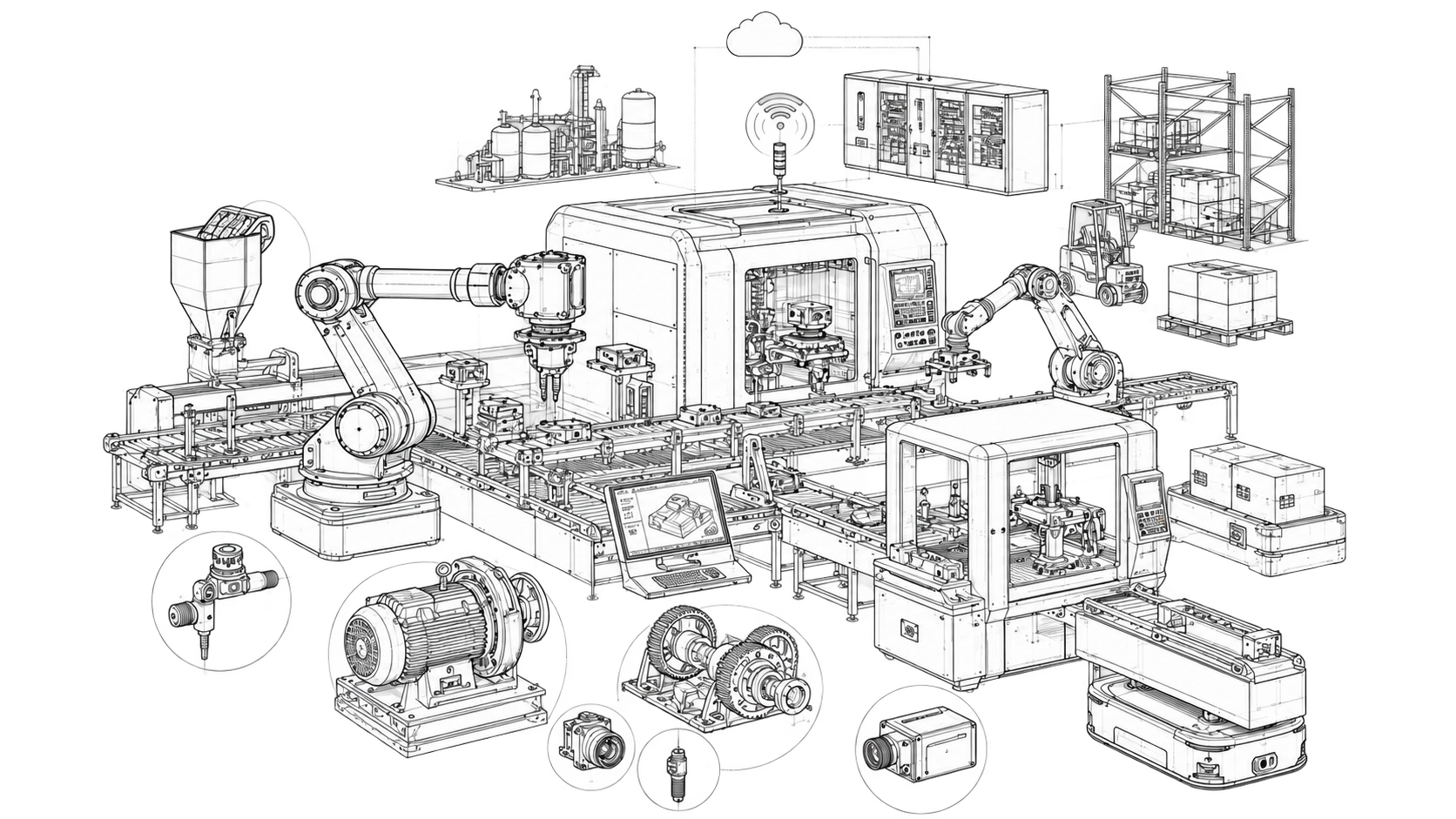
Manufacturing operations shown in technical X-ray linework

The operating reality

The loss is not the breakdown you can see.It is the fifty per cent you cannot.

A factory does not lose money the way people picture it in the dramatic breakdown that stops the line and gathers a crowd. That event is visible, and because it is visible, it gets fixed. The real loss is quieter and far larger: the micro-stoppages, the reduced speed, the small quality rejects, the start-up and shutdown minutes, the power dip that resets a machine. Each is small. Each hides in a different place. Together they are the difference between a line running at world-class output and one running at half of it and none of them is visible as a single number until the period is closed.

It compounds because the three things that make output availability, performance and quality leak independently and interact. A machine that runs slightly slow produces slightly more defects; a small stoppage forces a restart that costs quality; a quality hold idles a line that was already behind. No single reading captures the interaction, so the floor does the rational thing and works around each problem as it appears and every workaround masks the true number a little more. Studies find the majority of plants carry hidden workarounds that hide the real losses from the people accountable for them.

None of this is a failure of the operators, engineers or plant managers. It is the structural default of an industry whose systems were built to record each machine’s status and report the score after the shift, never to close the loop between a loss as it forms and the decision that would stop it. And here it is uniquely punishing: a small mechanical failure that once cost days to recover now costs weeks, because the part depends on a supply chain no one sequenced so a bearing becomes a fortnight, and the lesson that fortnight teaches leaves with the engineer who lived it.

Where OEE and unit cost are won or lost

The calls that decide the output, made after the shift is gone.

The degradation that is a service call today and a stoppage next week

An asset drifts a vibration, a temperature, a cycle-time creep and the window to intervene while it is still a planned maintenance job is measured in shifts. Miss it, and the same drift becomes an unplanned stoppage at six figures an hour, plus the weeks now needed to source the part. The decision was cheap while the drift was small. Nothing surfaced it as a decision in time.

The quality escape that is a scrap today and a recall later

A process shifts inside its own tolerance and the reject rate creeps up, buried in a cost code, invisible against a line that is still running. The cost is not only the scrap it is the escape that reaches a customer, the rework, the warranty, the reputation. The call to contain it had a window while the shift was small, and no system held quality and process as one to see it.

The schedule that slips upstream and misses a delivery downstream

A material arrives late, a changeover runs long, a line falls behind and the effect on a committed delivery is not visible until the commitment is already at risk. Each disturbance is manageable alone. Their combined effect on the date is what no report connects while there is still a resequence that holds it.

A works seen only when the score is reconciled

Plant leadership sees OEE, yield and unit cost in the monthly review, in arrears, when every maintenance, quality and scheduling decision that picture would have informed is already made or missed. The works is run on a rear-view of itself precise about last month’s losses, blind to the ones draining the line right now.

These are not four problems for four tools. They are one failure a loss no system sees while it is forming surfacing across availability, quality, schedule and cost at once. No single reading sees the works as one, and no system on the floor was ever built to.

The plant operating model

One loop across the whole works and it closes the loss before the score confesses it.

Every system a plant runs today is a rear-view mirror sold as a windshield. It records what each machine did, with precision, and hands you the score after the shift when the loss is already booked. Quantos is not that. It is an enterprise-grade, multi-tenant closed-loop intelligence system, and the loop does not break at the point a person reads the report, which is the exact point every OEE dashboard fails.

It reads the works as one live position availability, performance, quality, schedule and cost connected, not four losses reconciled in a monthly review. And then it does what no reading and no dashboard does: it runs the whole decision, end to end, and does not stop until the loss is closed. It ingests the line as it runs and rolls it up into one position. It forecasts the forming loss the degradation, the quality drift, the schedule slip before it lands. It prices that loss as risk, in money and hours, while the shift can still be saved. It issues the intervention as an accountable action to a named owner, with the evidence attached and the reason stated and where the call is safety-critical, it puts it in front of qualified authority, it does not take it. It tracks whether the action was executed. It captures what the line actually did. It scores its own original call against that outcome. It learns the failure pattern. And it corrects itself, so the next shift carries the lesson the last one paid for. Not a step of that is a person reading a dashboard after the fact. It is one deterministic loop, running continuously, that keeps thinking long after every other system has gone dark.

This is not an MES, an OEE platform or a predictive-maintenance tool it is not a factory product at all. It is a deterministic closed-loop intelligence system, and manufacturing is simply the environment where the invisible loss is largest and closing it shows the fastest. Those tools measure the works and stop. Quantos decides, proves and improves across every line as one. The industry has spent a decade getting better at scoring the plant. Quantos closes the loop that produces the score.
Evidence from your own plant

The output you lost, drawn against the output the loop would have held.

Read the incumbents’ own words. An MES records production. An OEE platform reports the score. A predictive-maintenance tool flags one asset’s failure. Every one of them ends at the same place: a number, or an alert, handed to a person after the loss has already formed. None of them checks whether the intervention held, scores its own call against the outcome, or corrects the pattern that failed. None of them closes the loop because none of them holds the works as one live position and carries its own decision through to the result.

Quantos holds the forecast, the intervention it recommended, whether the plant acted, and what the line then did. So it can show the one thing no OEE system can: the output and the cost the works actually carried, against the output and cost it would have carried had every call been made while the shift could still be saved. The distance between them is the loss the open loop let through the hours down, the units scrapped, the deliveries missed drawn in the plant’s own money, not an estimate, not a benchmark, the output that was really there and really recoverable.

And the shape is the whole cruelty of a factory. The gap widens, because a drift no one scored is not one stoppage it is the same failure recurring, shift after shift, unlearned, until it is the pattern that defines the line. Quantos holds one discipline here without exception: the gap is shown, not filled. It never invents a flattering version of the plant’s history. It shows, with evidence, the output that was truly there to hold because on a line where an hour is worth six figures, an answer you can audit is the only one worth acting on.

Why this cannot be answered by a better dashboard

Three things no rear-view system can do, at any price.

It draws the world that did not happen

Because Quantos alone holds the call it made, whether you acted on it and what then occurred, it can show the output and the money you would have held had every call been taken against what the line actually produced. No MES, no OEE platform, no maintenance tool can draw that line, because none of them carries the outcome of its own advice. It is the one view on the floor a competitor cannot copy, because copying it means closing the loop, and they have not.

It keeps a scored record of every call it ever made

Every intervention, and whether it was right, held permanently a provable track record of the system’s own judgement, shift after shift. Not a dashboard that resets each morning, but an accumulating body of evidence that says, in your own data, here is what we called and here is how it landed. No non-loop system can produce it, because none of them ever kept the score of its own decisions.

It is the only system that gets better while the line runs

Your MES and OEE tools are exactly as good today as the day they were commissioned. Quantos is not. Every shift it scores its own call, learns the failure pattern and corrects the next so the works it runs this quarter is sharper than the one it ran last quarter, and sharper again the quarter after. It compounds. A rear-view system can only ever describe a plant that is standing still. Quantos improves one that is running.

This is why Quantos is not a better factory tool. It is a different category of enterprise intelligence a deterministic closed loop that decides, proves and improves and a plant is simply where the loss it closes is largest.

Proof on your own line, not a projection

We do not ask you to trust a forecast. We replay your last quarter, shift by shift.

A forecast is a claim about a future you can argue with. Quantos offers something no argument survives: your own works’ history, replayed. Run the loop backward across the quarter the plant has already run, and watch every call it would have made appear in sequence the degradation flagged the shift it began, not the week it stopped the line; the quality drift named before it became a scrap run; the schedule slip caught while there was still a resequence that held the delivery. Each one timestamped ahead of the loss it saw coming.

This is not a demonstration built on our data. It is built on yours, and it settles the only question a plant manager actually asks: not “can this system monitor,” but “would it have held the output on my line, on the failure that actually cost me the shift.” The loop scores itself against the OEE that truly landed, in the open, and lets you judge the record before you ever run a line on it. No other system can offer that, because no other system held the whole works as one live position long enough to have the record.

Where Quantos sits

Your systems remain. Quantos closes the loop above them.

Quantos does not ask a manufacturer to replace anything. The ERP, the MES, the OEE and maintenance systems, the quality and scheduling platforms they stay, and they stay the systems of record. They were built to record, monitor and report, and they do it well. And the decisions that must stay with qualified people how a safety-critical asset is maintained, when a line is stopped remain entirely with the plant’s authorised engineers. Quantos surfaces and governs; it does not take those calls.

What the existing stack was never built to do is hold the works as one live position and carry the decision forward: to see the loss as it forms, decide while the shift can still be saved, measure the output, score the call, and keep the lesson when an engineer leaves. That layer has simply never existed. It exists now, it is the only thing Quantos adds, and it is deterministic, governed and evidenced end to end no black box, no fabricated output. The plant keeps everything it has built and gains the layer that turns a works running blind at half its potential into one that sees and closes the loss in time.

For the people who own the output

What plant and operations leadership ask first.

Is this an OEE, MES or predictive-maintenance system?

No. Those measure the plant and hand you the score after the shift. Quantos closes the loop forecasts the forming loss, prices it in money and hours while the line can still be saved, drives the decision, scores it against the output and corrects the next. Measurement is where they end. It is where Quantos begins.

Why do we run at half our potential without seeing it?

Because the loss is invisible until it is counted. Availability, performance and quality leak separately, the floor masks them with workarounds, and the true cost surfaces only when OEE is reconciled after a full period at half output. When plants measure honestly, recorded downtime jumps a third, not because more occurred, but because it was always there. Quantos surfaces each forming loss while the shift can still be saved.

Can it run across our lines and plants?

Yes. Quantos is enterprise-grade and multi-tenant built to run many lines and plants as one loop. Each line keeps its reality; operations finally sees the whole works as a single forward position, not a set of OEE reports reconciled after the period.

How do we act on a call we cannot see inside?

You do not have to. Quantos is deterministic every call traceable to its evidence, reproducible, governed, and safety-critical maintenance left with qualified authority. No black box, no hallucination. On a line where an hour is worth six figures, an answer you can audit is the only one worth acting on.

Quantos Systems · Manufacturing & Industrial

Every loss sent a signal first.Nothing was built to act on it.Now something is.