The Enterprise Has Systems of Record. It Still Has No Memory.
Enterprises preserve transactions, documents and dashboards with extraordinary precision. What they still fail to preserve is why consequential decisions were made, whether those decisions worked, and what the institution should learn from the result.
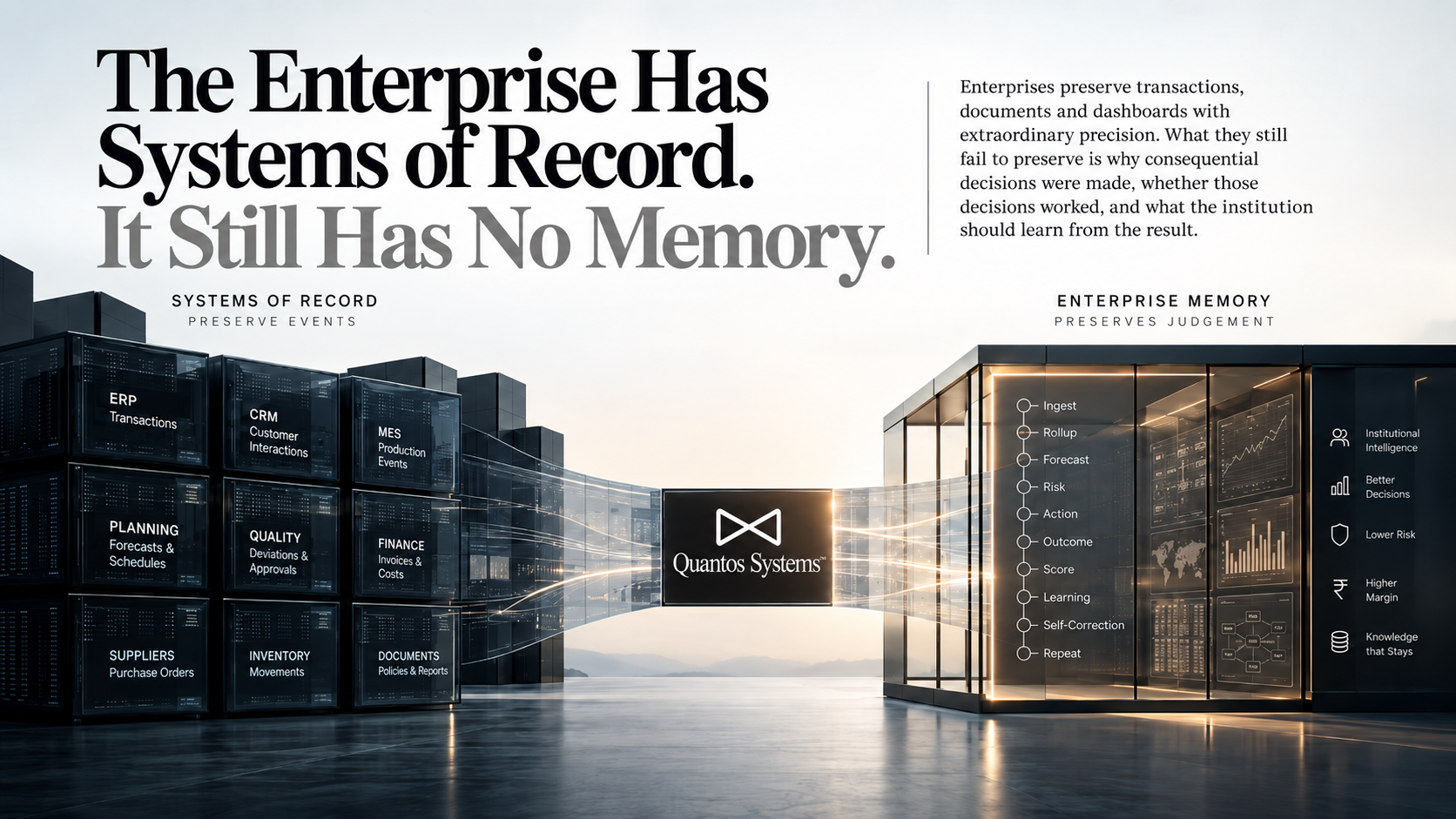
The Enterprise Has Systems of Record. It Still Has No Memory.
Modern enterprises have built extraordinary machinery for preserving activity. ERP platforms record transactions with precision. CRM systems preserve customer interactions. MES platforms capture production events. Quality systems retain deviations, approvals and test results. Planning platforms preserve forecasts, schedules and replenishment decisions. Data warehouses hold years of historical state. Document systems preserve policies, procedures and reports. Yet despite this extraordinary accumulation of information, most enterprises still fail to preserve the thing that matters most when a consequential decision is made: why that decision was taken, what evidence supported it, what outcome was expected, what actually happened, and what should change because of the result.
This is the difference between having records and having memory.
A system of record can tell the enterprise that 10,000 units moved from one warehouse to another, that a purchase order was accelerated, that a production sequence changed, or that a batch was rescheduled. What it usually cannot tell the institution, as one connected decision chain, is that the movement occurred because demand was expected to exceed available inventory in 17 days; that two alternative interventions were evaluated; that a service constraint prevented a larger transfer; that ₹4.2 million of exposure was expected to be protected; that the action was authorised under a specific operating policy; and that the realised benefit was only ₹2.7 million because demand softened after the intervention.
The transaction survives. The reasoning, consequence and correction usually do not.
That distinction is not semantic. ### It is architectural.
Systems of record preserve events. Institutions need to preserve judgement.
Enterprise software was largely built to answer questions of state: what was ordered, what was produced, what was shipped, what was invoiced, what inventory exists, which customer interacted with the organisation, which batch passed quality, which transaction was approved. These systems are indispensable because they establish operational truth. But operational truth is not the same thing as institutional intelligence.
Institutional intelligence requires continuity across the entire life of a decision. The enterprise must know what operating state existed at the time, what future state was expected, what risk was identified, what value was exposed, which constraints applied, what alternatives existed, what action was selected, who or what had authority, whether that action was actually executed, what happened afterwards, how reality differed from expectation, and what the institution learned from that difference.
Without this continuity, an organisation may possess decades of historical data and still repeat the same operational mistakes. A procurement function may retain every purchase order it has ever issued and still be unable to determine which procurement interventions repeatedly created excess inventory. A supply-chain organisation may preserve every stock transfer ever executed and still not know which transfers protected service without creating unnecessary economic damage somewhere else in the network. A manufacturing business may hold years of production and downtime records while still depending on a small number of experienced people to remember which interventions actually resolved a recurring constraint.
The enterprise has evidence.
What it often lacks is decision memory.
A system of record preserves what the enterprise did. Institutional memory preserves why it did it, what happened because of it, and what should be different next time.
That distinction explains why enormous technology estates can coexist with extraordinary dependence on individual judgement.
A senior planner may know that a particular customer's demand pattern changes before quarter-end. A procurement leader may understand that a supplier's stated lead time and actual lead time diverge under certain operating conditions. A plant leader may know that a theoretically efficient production sequence creates a downstream bottleneck that is invisible in the planning model. A commercial leader may recognise that one apparent demand increase is temporary while another signals a structural shift. A finance leader may know that one category of inventory appears healthy in the ledger but repeatedly traps working capital beyond its economic value.
These are not anecdotes. They are accumulated operating intelligence.
They influence capital, service, margin, production and risk.
Yet in many organisations this intelligence belongs less to the enterprise than to the individuals carrying it. When those people leave, the systems remain, the transactions remain and the historical data remains, but a large part of the judgement disappears with them.
What appeared to be organisational capability was often privately held memory.
Knowledge storage is not institutional learning.
The obvious response has historically been knowledge management. Enterprises build document repositories, standard operating procedures, knowledge bases, lessons-learned libraries, project archives and increasingly vector databases and retrieval systems capable of finding information across large volumes of corporate content.
These technologies are useful. They solve an information-access problem.
They do not necessarily solve the institutional-learning problem.
A post-mortem can document why a decision failed without changing the next forecast. A planner can write that a supplier's lead-time assumption is unreliable without causing the next decision process to reduce confidence when the same operating condition appears again. A review meeting can conclude that a stock transfer protected availability but cost more than the service exposure it prevented, while the next recommendation engine continues to optimise the same local metric in the same way.
The enterprise may have documented the lesson.
The system has not learned it.
That is why documents are not decision memory, search is not decision memory, retrieval is not decision memory, and a large language model summarising historical material is not automatically decision memory. The missing element is not access to the past. It is the causal connection between the past decision and the future behaviour of the institution.
For memory to become intelligence, experience must influence what happens next.
Closed-Loop Intelligence turns consequence into memory.
This is the architectural problem that Closed-Loop Intelligence is designed to solve.
The operating cycle can be represented as:
Ingest → Rollup → Forecast → Risk → Action → Outcome → Score → Learning → Self-Correction → Repeat
The significance of this sequence is not that it creates another workflow. Its significance is that it makes the entire decision lifecycle persistent and connected.
Operational evidence enters from the enterprise's existing systems. That evidence is assembled into an operating state rather than treated as a set of disconnected records. The system reasons forward to determine what is likely to happen if that state continues. The forecast is translated into a meaningful consequence: money, time, service, capacity, working capital, margin, exposure or another enterprise-defined measure. A corrective action is generated within the authority and constraints applicable to that decision.
But the intelligence cycle does not stop because an action was recommended.
It does not stop because somebody approved it.
It does not stop because a workflow closed.
And it does not stop because an API returned success.
The system waits for reality.
Did the expected condition occur? Was the intervention executed? Did it happen in time? Did the expected value materialise? Was the underlying risk actually reduced? Did the action protect service while causing another problem elsewhere? Was the outcome partially effective, ineffective or materially different from what was expected?
Only after reality returns can the institution determine whether the original judgement was correct.
The expected outcome is compared with the actual outcome. The variance is measured. The decision is scored. The evidence becomes learning. And, where the evidence justifies it and enterprise authority permits it, that learning changes the next cycle.
This last step is the difference between retaining history and accumulating intelligence.
The loop is not closed because an outcome was recorded. The loop is closed when the outcome changes what the enterprise does next.
If a system predicts a shortage, recommends a transfer, observes that the intervention failed because inbound inventory was already arriving, and then makes the same recommendation under the same conditions in the next cycle, there has been no meaningful learning. The organisation has merely created another record.
A Closed-Loop Intelligence System requires the consequence of the previous decision to influence subsequent forecasting, confidence, operating policy, action selection, thresholds or another governed element of the next decision process.
That is what makes institutional intelligence cumulative rather than episodic.
The AI era makes this problem larger, not smaller.
Artificial intelligence is often presented as the answer to organisational knowledge loss. In reality, without the right architecture, AI can reproduce the same failure in a new form.
Human judgement historically disappeared when experienced people left. Machine judgement can disappear when a prompt ends, a context window expires, a model is upgraded, an agent is replaced, a workflow changes or an external provider is swapped.
If an enterprise allows AI models and AI agents to participate in consequential decisions without preserving the full decision lineage and outcome independently of the mechanism that produced them, it risks replacing temporary human judgement with temporary machine judgement.
The technology changed.
The institutional problem did not.
This matters because the next generation of enterprise systems will increasingly use agentic AI to reason and act across supply chain, procurement, manufacturing, quality, finance, pricing, infrastructure and other consequential environments. An AI agent may determine that inventory should move, procurement should accelerate, production should be re-sequenced, a customer condition requires intervention, or capital should be repositioned.
The agent may execute perfectly.
But the institution still needs to retain why the decision was made, which evidence supported it, what constraints governed it, what economic consequence was expected and whether the result justified the original reasoning.
This leads to a critical principle for enterprise AI:
The enterprise should own the learning even when it does not own the model.
Foundation models will change. Agent frameworks will change. Technology providers will change. Models will be upgraded, replaced and commoditised.
The institution's accumulated operating experience should not disappear with them.
The record of what was known, what was expected, what action was selected, what happened afterwards and what was learned must belong to the enterprise itself.
That is not merely data ownership.
It is sovereignty over institutional intelligence.
History and experience are not the same asset.
The distinction can be stated more precisely.
A company may possess twenty years of transactional history and still repeat the same operating error because nobody preserved the relationship between the decision and its consequence in a computable form.
The institution has history when it knows what happened.
It has experience when it knows what happened because of what it did.
It has intelligence when that experience changes what it does next.
This progression is what conventional enterprise software rarely completes.
A stock transfer recorded in an ERP is history.
Knowing that the transfer protected ₹5 million of service exposure but created ₹800,000 of unnecessary logistics and inventory cost is experience.
Allowing that result to influence the next transfer decision is intelligence.
A procurement acceleration recorded in the purchasing system is history.
Knowing that the acceleration prevented production loss but subsequently created obsolete stock is experience.
Changing the next procurement decision because the system has retained that consequence is intelligence.
A production intervention recorded in MES is history.
Knowing that the intervention increased output locally while creating a downstream bottleneck is experience.
Using that result to change the next operating decision is intelligence.
This is why more data alone does not make an enterprise more intelligent.
The intelligence lies in the retained relationship between cause, action and consequence.
Decision memory becomes an enterprise asset.
When this relationship is preserved systematically, every consequential decision can become a durable institutional asset.
Decision memory contains more than an audit trail. It can retain the operating state at the moment the decision was made, the evidence available at that time, the expected future condition, the risk and economic exposure, the constraints and authority boundaries, the alternatives evaluated, the selected intervention, the expected outcome, the actual outcome and the correction applied afterwards.
Over time, this creates something no individual employee, dashboard or historical database can hold alone: a continuously accumulating body of enterprise judgement.
The institution can begin to know which interventions work under which operating conditions. It can distinguish repeatable evidence from anecdote. It can identify where assumptions repeatedly fail. It can determine where confidence should decrease. It can understand which operating constraints protect value and which introduce unnecessary friction. It can measure whether an intervention actually created net enterprise advantage instead of merely improving one local metric.
That accumulated judgement can become more strategically valuable than the underlying model.
Models can be licensed.
Cloud infrastructure can be rented.
AI agents can be deployed.
Data can often be purchased or reconstructed.
But institutional judgement accumulates through the interaction between the enterprise's own decisions and reality. It develops over time, it reflects the unique operating conditions of the institution, and it compounds every time the decision loop is completed correctly.
Two companies may eventually use the same foundation model, the same ERP, the same planning platform and even similar AI agents. Both may receive the same initial recommendation.
One company executes the recommendation, observes the outcome, measures the consequence, retains the variance and changes its next cycle.
The other executes the recommendation, records the transaction and moves on.
After enough cycles, these are no longer equally intelligent enterprises.
One has accumulated judgement.
The other has accumulated activity.
Quantos: making intelligence institutional.
Quantos was built around this missing layer.
It does not require enterprises to replace the systems already responsible for operational truth. SAP can continue recording transactions. Oracle can continue managing enterprise processes. MES can continue preserving manufacturing state. Quality and laboratory systems can continue enforcing validated processes. CRM can continue preserving customer interactions. Planning systems can continue planning. AI models and AI agents can continue reasoning and acting where the enterprise authorises them to do so.
Quantos operates above and across that environment as a Closed-Loop Intelligence System, connecting operational evidence to forward consequence, governed action, verified outcome, measurable learning and self-correction.
The objective is not to create another repository of historical decisions. It is to allow the institution's accumulated experience to become part of the mechanism producing the next decision.
That distinction matters because the competitive advantage of the next decade is unlikely to come simply from possessing more data. Every serious enterprise will have enormous amounts of data. It is unlikely to come simply from accessing a more powerful foundation model; leading models will increasingly be available to everyone. It will not come merely from deploying more AI agents; agentic capabilities themselves will become infrastructure.
The more durable advantage may belong to the organisation that can accumulate judgement faster than its competitors.
The institution that remembers why decisions were made.
The institution that knows which interventions actually worked.
The institution that can distinguish experience from anecdote.
The institution that knows when its assumptions have failed.
The institution that can convert consequence into correction.
The institution whose intelligence does not disappear when an employee leaves, a consultant exits, an agent is replaced or a model changes.
The institution whose next decision is demonstrably better because the previous decision happened.
Data gives an enterprise history. Systems of record preserve that history. Closed-Loop Intelligence turns experience into institutional memory — and institutional memory allows intelligence to compound.
Quantos exists to make that intelligence institutional.
Quantos exists to make that intelligence institutional. If your organisation is trying to preserve operational judgement, govern consequential AI-driven decisions, or build a measurable learning loop across enterprise operations, use the Quantos enquiry form below to start the discussion.