The Gap Open Loops Leave — And Why Defence Feels It First
Every defence enterprise in the world records what it spends with precision. Almost none closes the distance between knowing and correcting. That distance is where readiness leaks — and the failure is structural, not national.
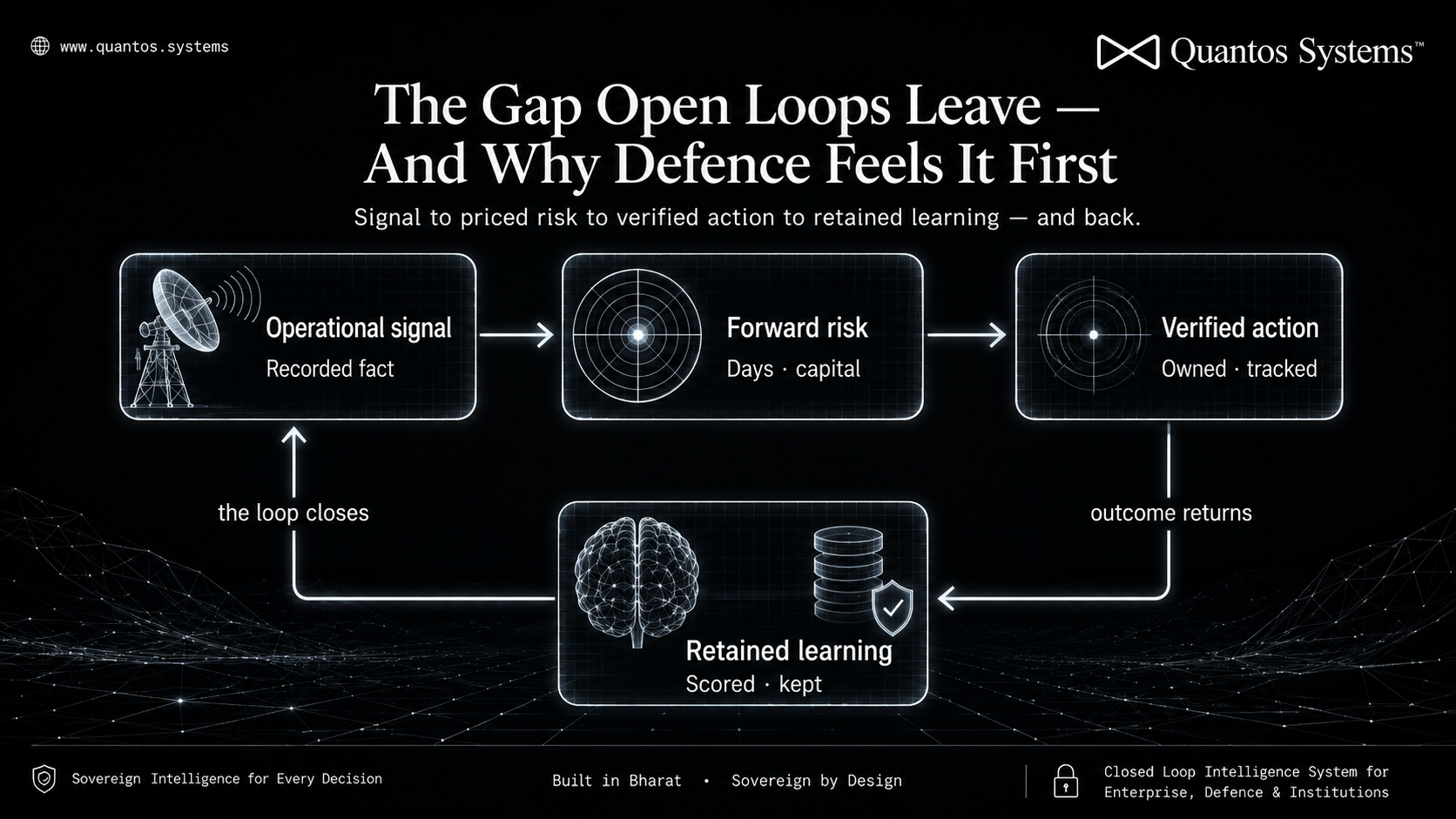
The problem was never the budget, and it was never the record. Defence enterprises fund themselves at scale and capture that spending with precision. Every sanction, every contract, every stores ledger is written down faithfully. The record has never been the weakness. The decision has.
Across every defence establishment in the world, a single pattern repeats. It is not a shortage of systems. It is a shortage of correction. A holding falls below the level it should sustain. A development programme drifts past its schedule and its cost. An emergency mechanism built for speed delivers late. A programme overruns by years. These are not isolated failures of individual officers or vendors, and they are not the failing of any one nation. They are the same failure, wearing different uniforms, in every corner of every defence enterprise: the system saw the signal, handed it to a person, and never found out whether the correction was made.
That is what an open loop costs when the stakes are readiness.
The front half is solved everywhere. Modern defence institutions can record, integrate, and report. Stores systems know what is held. Programme systems know what was planned. Procurement systems know what was contracted. The forward half of intelligence — capturing the operational fact — is mature. What has no home is the back half: pricing the risk before it binds, verifying that the corrective action was actually taken, scoring the outcome against the forecast, and carrying that learning into the next cycle so the same shortfall is not rediscovered years later. The record tells you what happened. Nothing tells you whether the institution acted on what it already knew.
Consider sustainment, where the gap is most measurable. An inventory system reports that stock exists. That is a true statement and a dangerous one. Stock existing is not the same as a formation being ready. Readiness is a forward position — consumption rate against holding, lead time against reorder point, the reserve against the days it would actually last under load. The stores ledger does not compute that. A person does, when a person has the time and the memory. When the shortfall surfaces later, it is not new information. It is old information that never closed the loop. The signal was present. The correction was not.
The same shape governs procurement. A programme does not fail at the tender. It fails earlier, when requirement, baseline, lead time, foreign dependency, budget window, and industrial constraint are evaluated as separate documents rather than one living position. A prime sees its first-tier vendors. It does not see the third-tier supplier whose delayed casting, seal, actuator, or alloy will stop the line three months out. By the time the slippage is reported, the constraint has already bound. The overrun was visible in the signals long before it was visible in the schedule — but no system was watching the whole position forward, pricing the exposure, and forcing the correction while it was still reversible.
This is why the answer is not another dashboard. Adding a better view of the same records closes nothing, because the failure is not one of visibility. The institution could see. What it could not do was finish the thought — carry the signal through to a priced risk, an assigned action, a verified outcome, a retained lesson. A closed loop is that missing back half, built into the architecture rather than bolted on. It ingests the same operational signal the record already holds, rolls it into one forward position, prices the exposure in concrete terms — days of readiness, capital at risk — produces the specific corrective action, assigns it to an accountable owner, tracks whether it was executed, scores the result against the forecast, and carries what it learned into the next cycle. Remove any one of those stages and the loop opens again, and the shortfall returns on schedule.
The human authority does not move. This is the point that matters most in a defence environment, and it is deliberate. Closing the loop does not mean automating the command decision. The deployment, the commitment, the operational call remains with the officer who holds the authority to make it — always, and in the most serious environments, absolutely. What the loop changes is the quality of sight the decision-maker has when they exercise that authority. They decide with the forward position visible and priced, not on instinct and a stale ledger. And the reasoning behind the decision stays inside the institution after the officer transfers or retires. The judgment does not walk out in a farewell posting. The institution keeps its own intelligence.
Sovereignty is not a slogan here; it is an architectural requirement. An intelligence layer that reasons over a nation's readiness cannot depend on infrastructure the nation does not control. It runs on-premise, behind the air gap, with no operational data leaving the network. Such a system is only defensible if it is deterministic — the same signal producing the same reasoning every time, reproducible and auditable years later — and if the reasoning never leaves sovereign control. Those are not features added at the end. They are the conditions under which a system is allowed near the decision at all.
The gap is not a scandal to be exposed. It is a structural default to be closed. Open-loop systems observe, they report, and they stop — performing exactly as designed. The correction is the half that was never built. That is the half Quantos exists to close: not a better record of what went wrong, but the architecture that makes the same failure impossible to rediscover, because the institution acted on the signal the first time, scored the result, and carried the lesson forward.
The budget was never the problem. The loop staying open was.