Why AI Agents Need Closed-Loop Intelligence: The Missing Enterprise Control Layer
AI agents can reason, decide and act. But action is not a closed loop. The enterprise still needs a system that governs what happened next, measures whether the decision worked, retains the learning and changes the next cycle.
Why AI Agents Need Closed-Loop Intelligence: The Enterprise Architecture AI Still Does Not Have
Enterprise technology is entering a dangerous transition. For decades, the limitation was obvious: software could record what happened, calculate what existed and move transactions through predefined workflows, but judgement remained outside the system. Artificial intelligence changed that boundary. Models began predicting what might happen. Generative AI began reasoning over increasingly complex information. AI agents can now move further still, calling APIs, coordinating workflows, interacting with enterprise applications and executing actions with progressively less human intervention. Yet the architecture of the enterprise has not evolved at the same speed. We have given software the ability to act before giving the institution a reliable mechanism to determine whether that action was correct, what consequence it created, what was learned from the result and what must change the next time the same operating condition appears.
That gap is far more consequential than another debate about model accuracy. An AI agent can choose the correct tool, possess the required permission, successfully execute a transaction and return a technically successful result while making the enterprise economically or operationally worse. A procurement agent may accelerate an order that later becomes excess inventory. An inventory agent may transfer stock to protect service at one location while creating a shortage somewhere else. A pricing agent may improve conversion while destroying contribution margin. A production intervention may protect output while consuming constrained material required by a higher-value commitment. In every case, the software may have executed exactly as instructed. The workflow may be complete. The API may have returned 200. The audit log may show no error. Yet the decision itself may have failed. That distinction between execution success and decision success is where most current enterprise AI architecture breaks.
The reason is structural. ERP systems know transactions. Planning systems know plans. Workflow systems know whether tasks moved from one state to another. Identity systems know whether an actor was authorised. Observability platforms know whether a service ran. AI models know what they predicted. AI agents may know what tools they invoked and which steps they completed. None of those systems, by themselves, necessarily own the complete statement that matters to the enterprise: this evidence created this forecast; this forecast exposed this risk; this risk justified this action under these constraints; this consequence was expected; this action was or was not executed; this is what actually happened; this is the variance between expectation and reality; and this is what the institution must change because of it. Without that chain, the enterprise has activity, automation and intelligence fragments. It does not yet have a closed intelligence system.
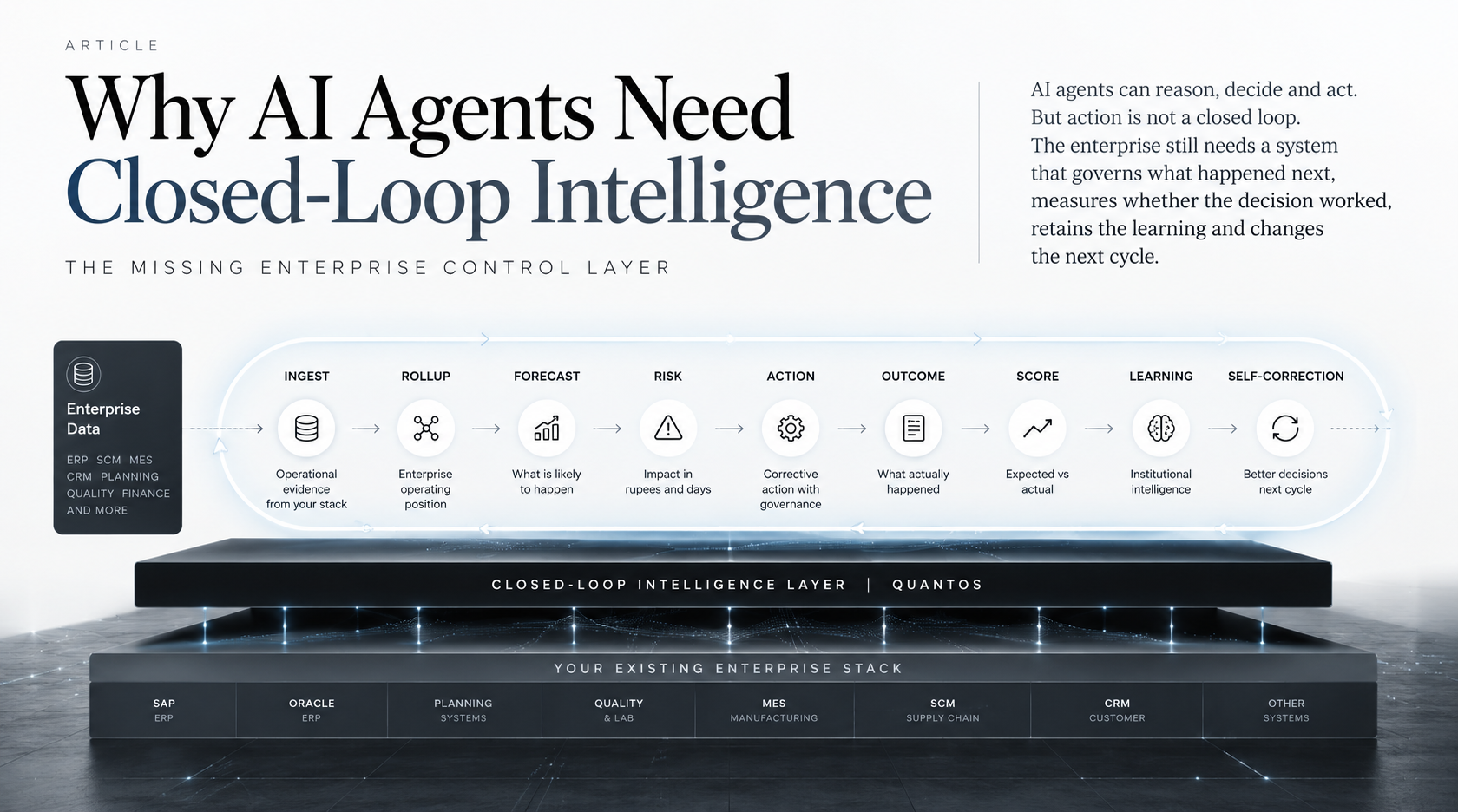
This is the problem Closed-Loop Intelligence solves. Quantos defines the enterprise decision cycle as Ingest → Rollup → Forecast → Risk → Action → Outcome → Score → Learning → Self-Correction → Repeat. The importance is not the number of stages. The importance is that each stage is causally connected to the next and that reality is allowed to come back into the system after the action. Operational evidence is ingested from the existing enterprise stack. That evidence is assembled into the relevant operating state. The system reasons forward to determine what is likely to happen. The future state is translated into measurable exposure such as money, time, service, working capital, capacity or another enterprise-defined consequence. A corrective action is then derived within the authority and constraints applicable to that decision. But the process does not stop because a recommendation was made or because an action was executed. The system waits for the outcome. It compares what was expected with what actually occurred. It scores the result, retains the learning and changes the next decision cycle where evidence supports that correction.
That last movement is what separates a real closed loop from an automated workflow. Recording an outcome is not enough. Producing another dashboard is not enough. Adding a feedback field is not enough. Even saying that a system "learns" is meaningless unless the learning produces a governed change in what happens next. The loop closes only when the consequence of a previous decision materially changes the next forecast, confidence, policy, action selection, operating boundary or another approved element of the decision process. If the system predicted a stockout, recommended a transfer, observed that the intervention failed because inbound inventory arrived earlier than expected and then makes the same decision under the same conditions next month, no meaningful learning occurred. The enterprise merely accumulated another record. Closed-Loop Intelligence requires the decision mechanism itself to become better because reality contradicted or confirmed what it previously believed.
This is also why AI agent governance, while necessary, does not solve the entire problem. Agent governance answers questions such as which agent may access a system, what tools it may invoke, what permissions it holds, what policies constrain it and when a human must approve an action. Those controls are fundamental. But permission and correctness are different dimensions. An agent may be fully authorised and still make the wrong decision. It may comply with every access rule while producing a financially destructive outcome. Enterprise AI governance therefore cannot stop at controlling whether an AI agent was allowed to act. A consequential enterprise also needs to know whether the action worked, what it cost, what it protected, what it displaced, what evidence supported it and what the institution learned after reality arrived. That is not merely AI agent governance. That is outcome governance.
The implications become more serious as enterprises introduce agentic AI into supply chain, manufacturing, pharmaceutical operations, banking, infrastructure, defence, procurement, pricing, quality and capital allocation. These are not environments where one decision exists independently of the rest of the system. Variables move at different speeds, under different constraints, with different economic consequences. Protecting one metric can damage another. Increasing availability can increase excess. Reducing inventory can increase service risk. Accelerating procurement can protect production while trapping working capital. A decision may appear correct locally and be destructive at network level. For this reason, enterprise intelligence cannot be reduced to generating the next best action. It must reason against the operating state of the enterprise, quantify the consequences of intervention and retain evidence about whether the intervention produced net benefit after the rest of the system reacted.
This is where the idea of institutional intelligence becomes critical. Most enterprises already possess enormous amounts of judgement, but much of that judgement does not belong to the institution in a computable form. It sits inside experienced employees, review meetings, spreadsheets, email chains, planning calls, informal exceptions and the memory of people who have seen similar situations before. When those people leave, much of the reasoning leaves with them. AI does not automatically solve this. In fact, badly designed AI architecture can create a new version of the same problem where judgement exists temporarily inside model inference, agent traces and conversations but never becomes durable institutional knowledge. The enterprise should not merely rent intelligence at the moment a model is called. It should retain the evidence of what was known, what was predicted, what action was taken, what actually happened and what was learned. That record must survive the person, the model, the agent and the vendor.
Closed-Loop Intelligence therefore creates something fundamentally different from another AI assistant or decision dashboard. It creates a decision memory for the enterprise. Over time, the institution can know which forecasts were reliable under which conditions, which interventions actually protected value, which assumptions repeatedly failed, where confidence should fall, which policy boundaries prevented damage, which actions were ignored, where expected economic benefit did not materialise and where the system should alter its next decision. This is not institutional memory as an archive. It is institutional memory connected directly back into execution. The enterprise does not simply remember what happened. It becomes capable of changing because of what happened.
The architecture also changes how we should think about autonomous AI. The goal should not be unrestricted autonomy. A system becoming more intelligent does not mean it acquires more authority. Quantos separates intelligence from authority. The system can forecast, quantify, recommend, observe, score and learn while the enterprise retains the right to define statutory constraints, contractual obligations, operating policies, approval requirements and execution boundaries. A hard constraint remains hard regardless of model confidence. A contractual commitment cannot be overridden because an algorithm prefers another outcome. A regulated decision can continue to require qualified human approval. This is essential because the future enterprise will need systems capable of learning continuously without allowing learning to silently rewrite the authority structure of the organisation.
The same separation applies to probability and accountability. Forecasts may be probabilistic because the future contains uncertainty. Machine-learning models may express confidence because evidence quality varies. But the evidence chain surrounding a consequential decision cannot become ambiguous. The enterprise should be able to reconstruct what data was used, what state existed, what forecast was produced, what risk was identified, which rules and constraints applied, what action was recommended, what authority governed the decision, whether the action was executed, what outcome occurred and what changed in the next cycle. The prediction may contain uncertainty. The accountability cannot. This becomes one of the defining requirements of enterprise AI as agents gain access to systems where decisions create financial, operational, regulatory or strategic consequences.
The deeper problem, therefore, is not that enterprises lack intelligence. They already have more analytical capability than at any point in history. They have ERP, planning, business intelligence, data platforms, machine learning, large language models and increasingly capable AI agents. The problem is that these technologies largely occupy different portions of the decision lifecycle. One records. One predicts. One recommends. One executes. Another monitors. The institution itself is left responsible for connecting cause to consequence and carrying learning into the next cycle. That is the open loop that has persisted underneath decades of enterprise software investment.
Quantos was built specifically for that missing layer. It does not require an enterprise to replace SAP, Oracle, its planning systems, its quality stack, its MES, its CRM, its operational databases or the AI models and agents it chooses to use. Those systems continue doing what they are designed to do. Quantos sits across the existing enterprise stack and turns fragmented operational intelligence into a persistent closed-loop mechanism. It connects what the enterprise knows to what is likely to happen, what the consequence means, what corrective action is justified, what actually happened afterwards and what the institution must learn before the next cycle begins.
The value of this architecture becomes most visible when the consequence is expressed in operational and economic terms. An enterprise does not ultimately need another alert saying inventory is high. It needs to know which inventory, where, how long it has been exposed, what future demand is likely to consume it, what capital is trapped, what alternative action exists, what constraint prevents movement, what the economic consequence of each intervention is and whether the eventual action actually released the expected value. It does not need another warning that a service failure may occur. It needs to know when, where, what is causing it, what intervention is feasible, what another intervention would displace and whether the chosen decision prevented the predicted loss. This is how AI moves from producing insights to becoming accountable to enterprise outcomes.
The distinction will become increasingly important because AI agents will continue improving. They will reason better, use more tools, coordinate more processes and operate across more of the enterprise. That progress does not reduce the need for Closed-Loop Intelligence. It increases it. The more capable the actor becomes, the more important it is that the institution can govern the decision, observe the consequence and retain the learning. Faster action inside an open loop does not create a smarter enterprise. It simply allows the enterprise to make uncorrected decisions faster.
The next generation of enterprise intelligence will therefore not be defined by which organisation has access to the most powerful model. Models will change. Agents will change. Vendors will change. What matters is whether the institution itself becomes more intelligent every time it makes a consequential decision. The enterprise must be able to prove what it knew, what it expected, what it decided, what authority applied, what happened, what value was created or lost and what changed because of the result.
That is the difference between artificial intelligence being used by an enterprise and intelligence becoming part of the enterprise.
That is the difference between automation and institutional learning.
That is the difference between an agent completing an action and an enterprise becoming better because the action occurred.
And that is why the AI era requires a Closed-Loop Intelligence System.
Quantos exists to close that loop.
If your organisation is deploying AI agents, operating across complex enterprise systems, or trying to convert forecasts and recommendations into measurable operational outcomes, contact Quantos to see the closed-loop system operating against a real enterprise decision cycle.